


 My blog
  Support me on Tipeee!


Sunday10November
Wake up at Imperio Residence.

The large window overlooks a small island under full construction and the Strait of Malacca.

The "Cheng Ho Replica", an old restaurant boat has been stranded here since 2022...;


The island is under full construction around the mosque "Masjid Selat Melaka"


Cheng Hoon Teng Temple
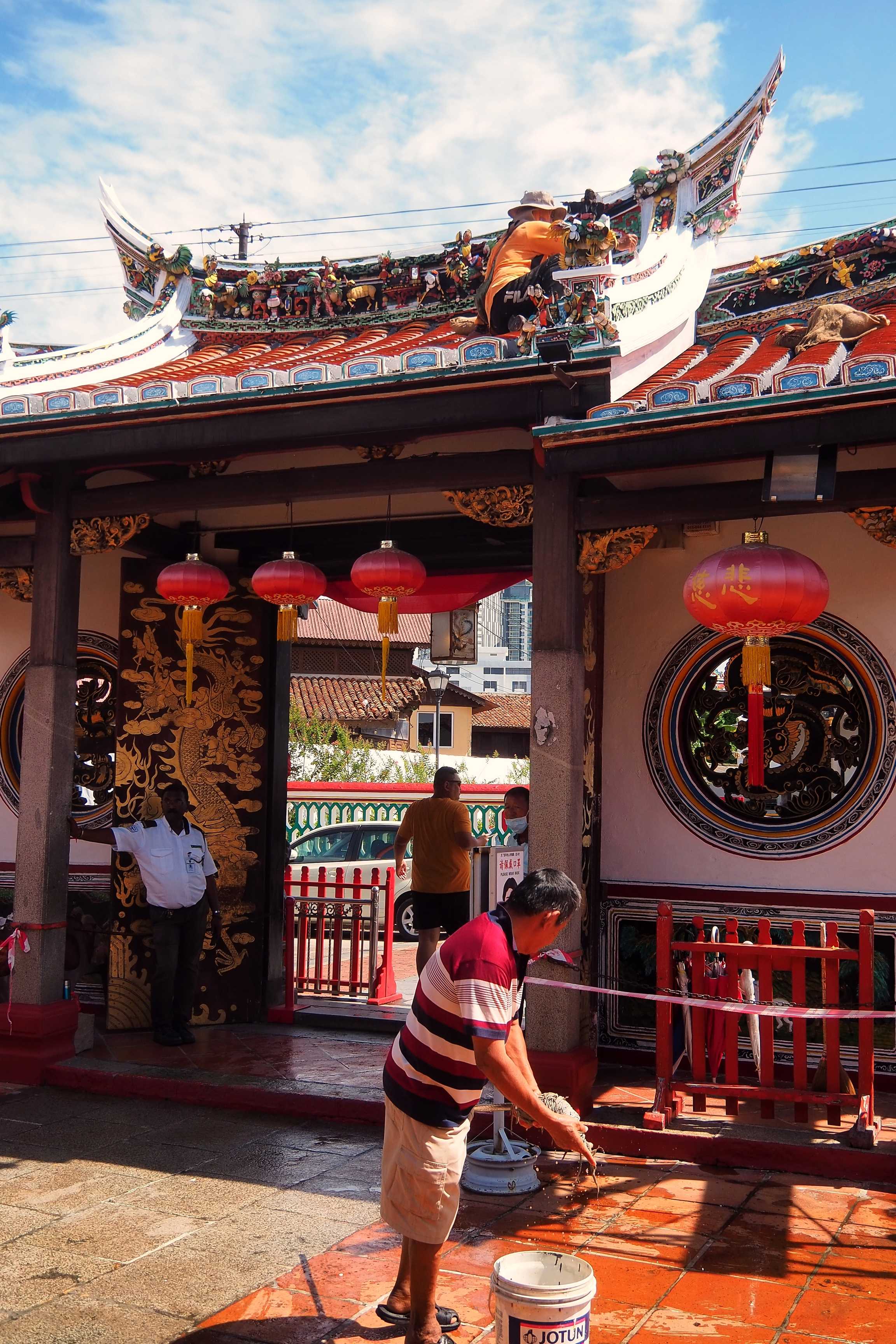
The day will be devoted to visiting the city. We start with the "Cheng Hoon Teng" temple.


The Cheng Hoon Teng temple is the oldest Chinese temple still in operation in Malaysia. Founded in the 17th century, it is dedicated to Kuan Yin, the Goddess of Mercy. In 2008, it was inscribed on the UNESCO World Heritage List as part of the historic site of Malacca.


The main prayer hall.


Guanyin, the Bodhisattva of Compassion, figure revered in Mahayana Buddhism.


Dressing the statues is an act of devotion, treating the deity as a living being. It is a form of puja, honoring the deity and "animating" its presence. Offering new finery allows accumulating spiritual merit (punya). The choice of clothes is highly symbolic. An orange robe adorned with dragons, as in the first photo, represents power and good fortune, often associated with Mazu. Another robe embroidered with lotuses symbolizes purity and spiritual awakening, perfect for Guanyin.


Under the main altar, "Tiger Generals".


This sacred space is dedicated to the memory and worship of ancestors. The countless ancestral tablets (Shenwei), arranged behind the glass and on the shelves, each represent a deceased person, tribute of the living thus ensuring perpetual memory.


The murals of Chinese temples are true visual narratives, intended to educate and inspire. Often drawn from great classics like "The Romance of the Three Kingdoms", they depict epic scenes.


Guan Yu, recognizable by his long beard and his "Guandao", symbolizes protection and loyalty. Zhang Fei defends the Changban bridge alone, embodying unwavering bravery.


This montage represents the Buddhist paradise inspired by Mount Putuo (Putuóshan), sacred island of China. In her cave, the goddess Guanyin stands on the waves, cranes symbolizing longevity at her sides. Around her, the Arhats (Luóhàn), enlightened disciples, populate the mountain, illustrating the diversity of paths to awakening.


The temple sports a curved ridge line, often called "swallowtail". This curve symbolizes the connection with the sky and the gods, but also protection against evil spirits, unable to move in a straight line according to Feng Shui principles.

On the frieze, don't miss the flag-bearing frog! 


The temple was awarded a UNESCO prize in 2003 for the architectural restoration of its main building, completed in 2001.


Unique offerings are often present. Here, we have a turtle modeled in dough. It embodies longevity, stability and wisdom in Chinese tradition. These offerings are made to invoke blessings and prosperity for the faithful without recourse to animal sacrifice. 


This statue sports the dark face and long black beard of Zhenwu Dadi (Xuantian Shangdì). This major deity of Taoism is often seen as a powerful protector and the god of the North. His clothes, adorned with blue dragons, underline his celestial power and his role as a warrior deity.


And more ancestral tablets.


The temple was built without nails according to Feng Shui principles with materials imported from China.


A stone pillar engraved with Chinese characters whose date, the year 1898, commemorates a renovation or a major dedication. 


The sculptures adorning the roof were created using the technique called Jiannian, a mosaic art in relief. Craftsmen assemble shards of colored ceramic to give life to mythological figures and animals.


The smoke rising from the incense is considered a means of carrying prayers and wishes to the deities. The bronze censer, adorned with stylized lion heads, is typical of Chinese temples. It is the place where the faithful plant their incense sticks after formulating their prayers.


Restoration is continuous. For now, it is the white paintings that are entitled to a refreshment.


We leave the temple to reach the Masjid kampung kling mosque.

The Kampung Kling Mosque
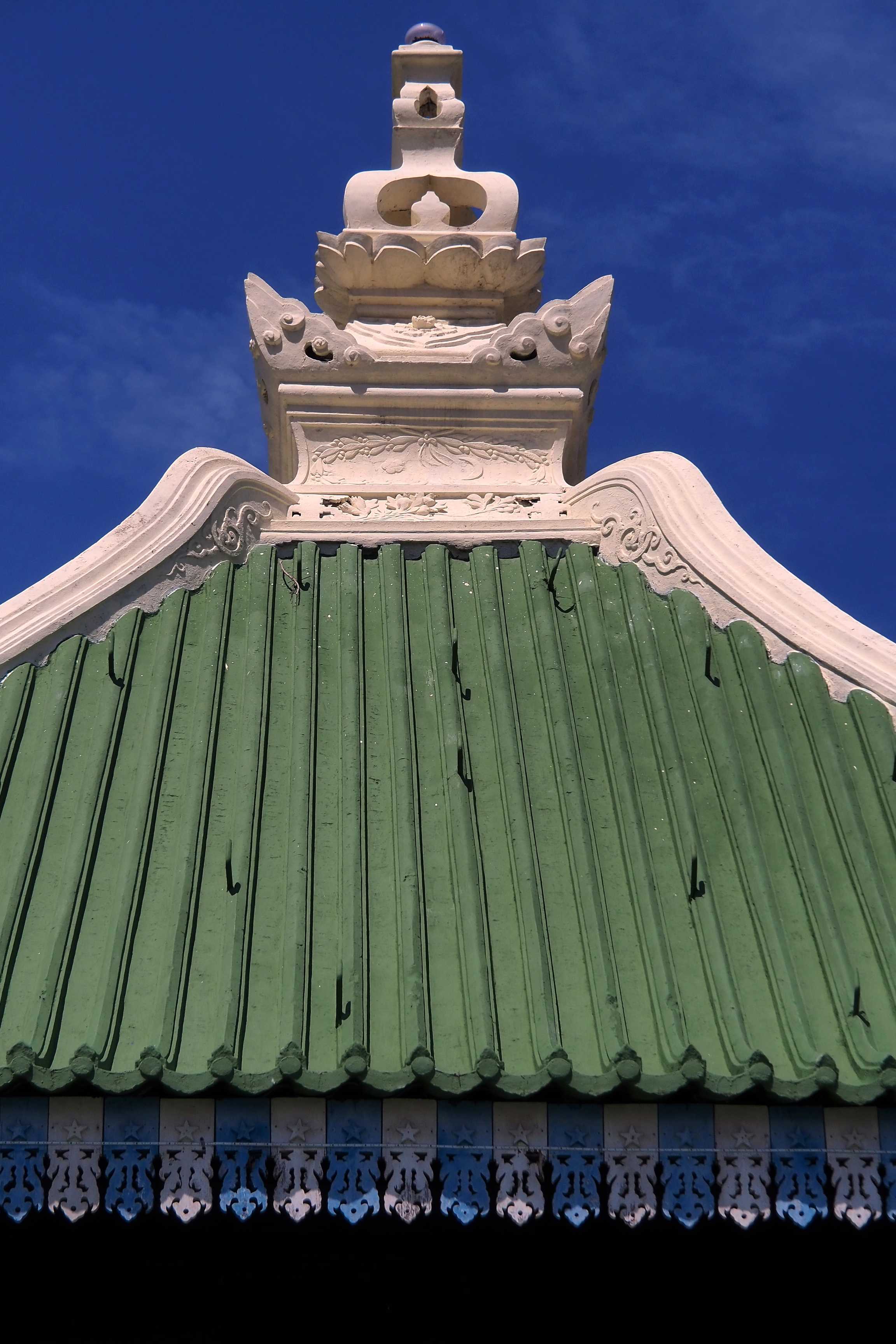
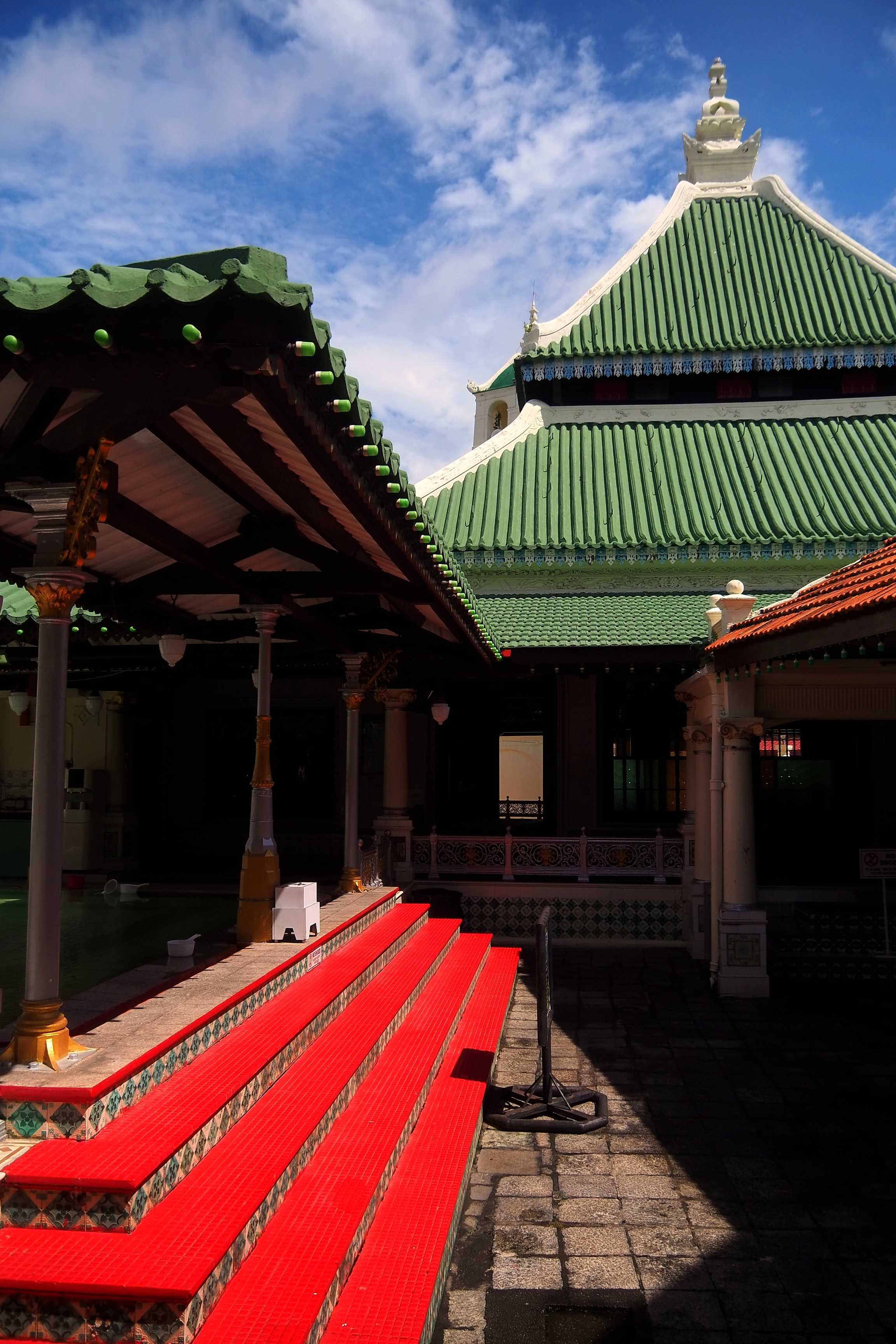
In the heart of the "Street of Harmony", the Kampung Kling mosque is an example of Malaysian architectural eclecticism. Its minaret is shaped like a pagoda and its columns are of European inspiration. A golden calligraphic inscription on its facade proclaims a verse from the Koran: "Only those who believe in God and the Last Day will populate the mosques of God".

The mosque cemetery houses a collection of ancient funerary steles. These tombs, known as batu nisan, have distinctive shapes that vary in meaning. Traditionally, the style of the stele could indicate the sex of the deceased: cylindrical or rounded shapes were often reserved for men, while flat shapes marked female burials... 


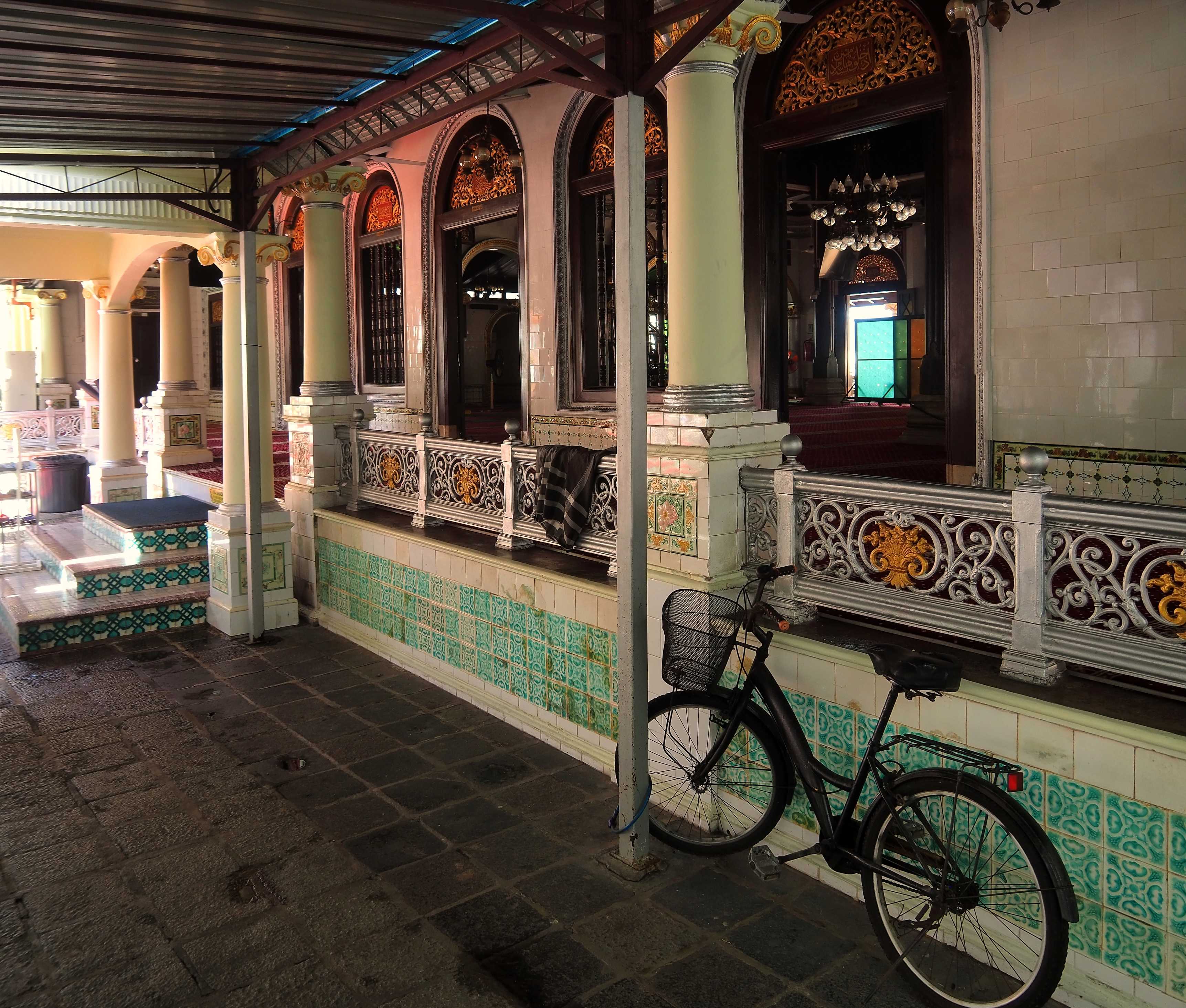
The prayer hall.

On the left photo, The wooden panel dating from 1334 of the Hegira (around 1915), sports a Koranic verse.


The short walk continues under a fiery sun.


Jalan Tukang Besi street exposes its historical strata. The walls worn by time discreetly leave room for a stylized orangutan for the art dealer "The Orangutan House".


Behind the bars, a traditional mask seems to observe the passer-by, while a "Berhenti" sign invites to mark the stop to soak up the atmosphere...


Fresco by Mohd Anuar, Malay artist.


The Melaka River crosses the historic city. Its banks mix Chinese shophouses and Dutch colonial buildings. Rehabilitated, this watercourse is now a tourist artery with cruises.


In this year 2024, designated for tourism, boats dedicated to "World Tourism Day" crisscross its waters, promoting a "Sustainable Transformation of Tourism".

The entrance to Jonker Walk avenue is guarded by a huge dragon. The mythical animal was installed to celebrate both the year of the dragon and the 50th anniversary of diplomatic relations between Malaysia and China.


Mamee Monster, sponsor of "Melaka 2024". Mamee Monster is an iconic crispy Chinese noodle brand in Malaysia, launched in the 1970s. Its fun concept is to eat the noodles raw, after crushing them and shaking them with the seasoning.


Malacca's Red Square is a testimony to the Dutch colonial past. The Stadthuys, with its scarlet facade, is one of the oldest Dutch buildings preserved in the East, built in the 17th century. By its side, the Christ Church, also painted red, and an iconic windmill, illustrate the architectural heritage of the Dutch East India Company.


Here, trishaws adopt contemporary themes that will embark you in the world of Pokémon and Minions...


The fountain of Queen Victoria (1837-1901), erected in 1904, another witness to the country's colonial past. It is the British who succeed the Dutch from 1824 to 1957.


Pekingese tourist (Canis familiaris) vs Malaysian tourist. 

Short tour in the red church of Melaka. Erected in 1753, it stands as the oldest Protestant church still in operation in Malaysia.


The History and Ethnography Museum
To enjoy a bit of coolness away from the Sun, we visit the Museum of History and Ethnography. It traces the evolution of this port city, from Malay sultanates to various colonial administrations. The museum is housed in the Stadthuys, the oldest Dutch building preserved in Southeast Asia. Built in the 17th century by the Dutch East India Company, this building once housed the administrative headquarters.


The historical foundations of Malacca.
This bronze statue represents Hang Tuah, the legendary Malay warrior of the Sultanate of Malacca, in the 15th century. He is an emblematic figure of bravery and loyalty in Malaysian history and mythology.


Old photos of traditional Malay weddings.


On the left, the Minangkabau wedding, recognizable by the imposing golden headdress of the bride, the Suntiang. The photo on the right presents the classic Malay style, with outfits in songket, where the groom wears a Baju Melayu and the bride a Baju Kurung, embodying the concept of "Raja Sehari", where the spouses are kings for a day.


The entrance to the literature museum.

Four figures of Malay literature are painted on this wall: Tun Sri Lanang, Syed Sheikh Al Hadi, Munshi Abdullahet and A. Samad Said.


This man on a Honda Cub "Special Edition" scooter moves his four poultry in the most natural way possible... 


Lunch break at the Tiong Hwa Hainan Chicken Rice restaurant in Malacca. It is an institution to taste the famous Hainan rice, served in balls with chicken. This culinary specialty had been adapted by Chinese immigrants from Hainan province.

The excellent meal with the famous rice balls. And it was at this moment that I thought the trip was going to stop there!!!  As (too) regularly, my back says stop! A pain in the lower back instantly blocks me without warning and I can no longer move... It is the unequivocal sanction of my body following what I inflicted on it the day before contorting myself in the too narrow galleries of the Gua Tempurung cave... Fortunately, the blockage will only be temporary, I will manage to move again (with more or less dignity...) and with the help of paracetamol, I will be able to resume the rest of the city visit...


The Jonker Walk, lively maze of traditional shophouses, dating from the Dutch and British periods.

A beca, or trishaw, entirely decorated on the theme of Kuromi, the Sanrio character. Kuromi is a popular character from the Sanrio family, known for its creations like Hello Kitty.

The replica of the Flor de la Mar, a Portuguese carrack of the 16th century, is the Maritime Museum (Muzium Samudera). In the distance, the rotating observation tower Menara Taming Sari, takes tourists up and down in a chain. We will be there later.


To relieve my back, we take the option of visiting in a sitting position in the boats of the city.


Then we chain with another sitting position but rotating this one. We embark in the rotating tower Menara Taming Sari to enjoy the nice 360 degree panoramic view of the city.


A fresco in Malacca represents actress Fan Bingbing in the role of Empress Wu Zetian, a central character in the Chinese TV series "The Empress of China".


To end the day, little relaxation and refreshment in the hotel pool.


The view from the apartment.


After the diurnal walk in the historic center, rebelote with the nocturnal walk.


Energy savings are not yet on the agenda of the city...


To shine as much as your neighbor, you surely need to have batteries as heavy as the rickshaws themselves...

After Pikachu, Minions and Hello Kitty, Spiderman invites himself to the party...


Bumblebee from Transformers has not yet managed to transform into a trishaw... He seems reduced to begging on the Tan Kim Seng bridge.


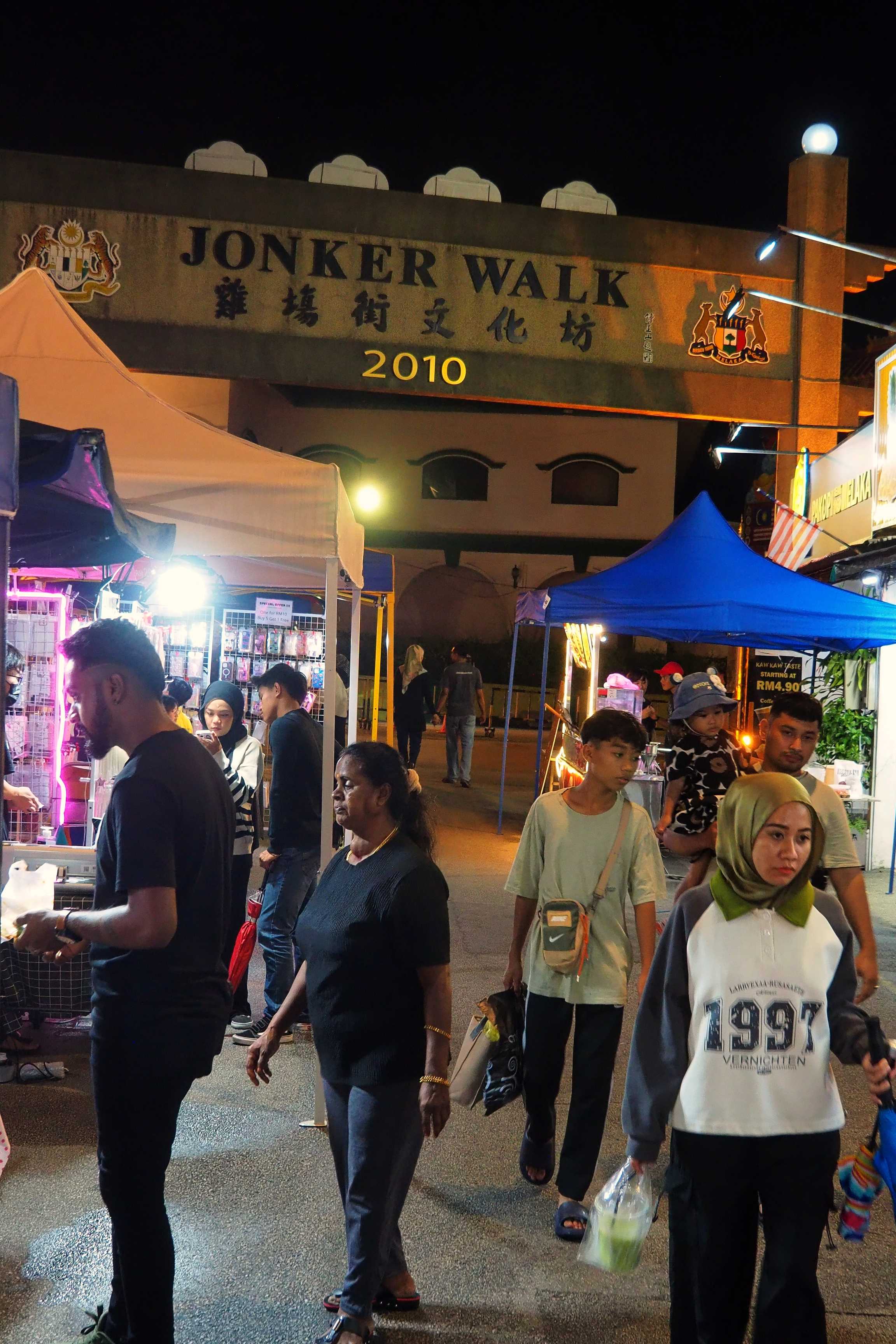
Jonker Walk
On weekends, Jonker Walk turns into a night market, where you can discover local culinary specialties, crafts and sales of all kinds.


Skewers galore!




Cheng Hoon Teng Temple
Passing in front of the Cheng Hoon Teng temple that we visited this morning.;


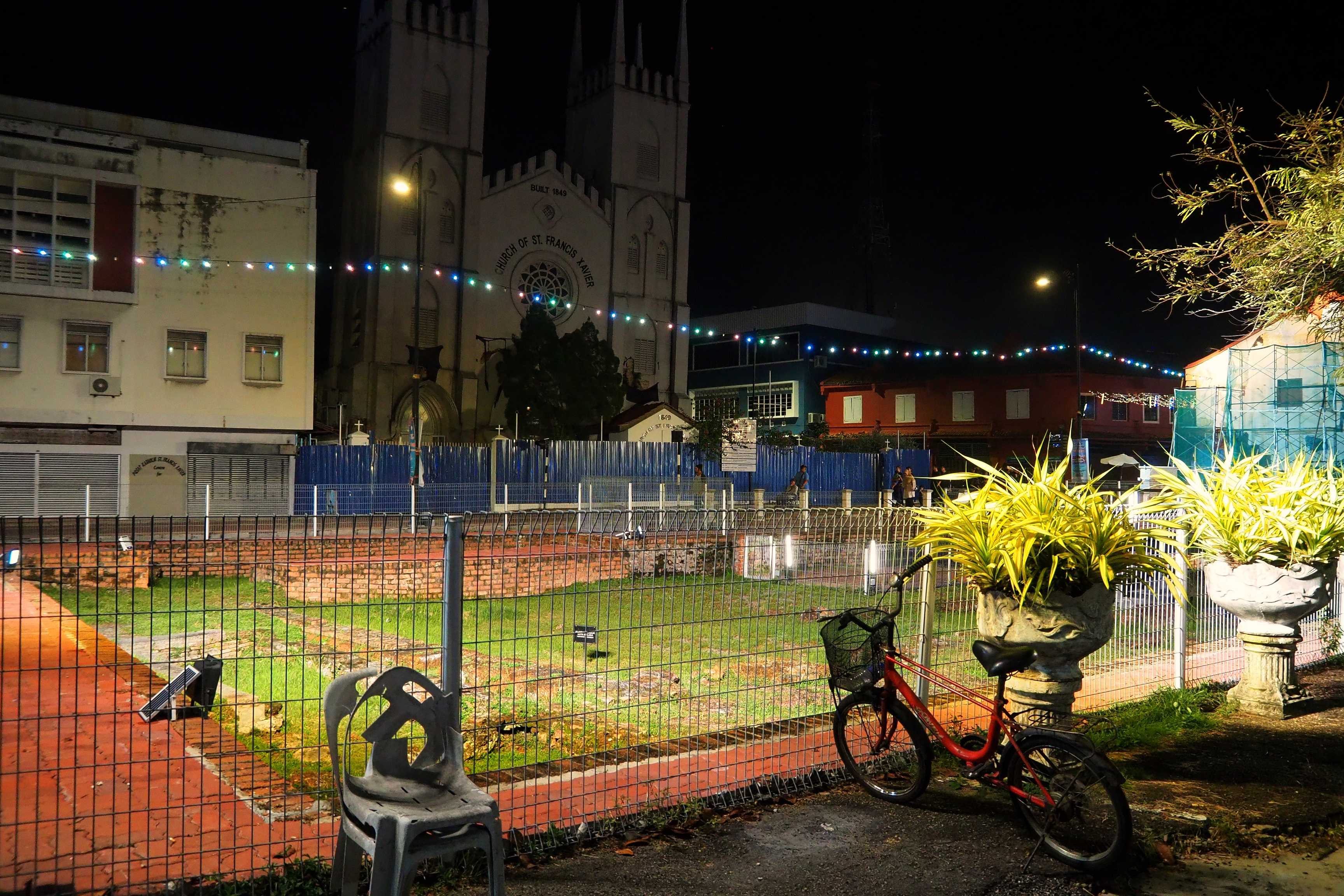
The church Saint Francis Xavier from 1856, another witness to the colonial heritage of the city.


The Lorong Jambatan and its restaurants.


For us, it will be The Bridge cafe.


Under the bridge Jambatan Chan Koon Cheng.

The always imposing church Saint Francis Xavier with its two gothic towers.

Return to the apartment and all its comfort. Malaysia practices very affordable prices for its accommodation, and we take advantage of it!


Monday11November
Wake up facing the Strait of Malacca. Today, we hit the road again to return to Kuala Lumpur for the end of our Malaysian trip.


Before leaving, short tour at villa Sentosa. This traditional Malay house (Rumah Melayu) on stilts can be visited, but its owner is not available right away for the visit!


This sheet metal house on stilts is not bad either.

We are November 11, it is high time to bring out the Christmas decorations! Especially the snowman, very common at these latitudes!

Lunch at the famous restaurant Beh Leh Hainam Satay, specializing in skewers in all its forms.


On the right, our dessert, a Cendol. On a bed of crushed ice, pandan rice noodles, coconut milk and sweet red beans harmonize. The Malacca version is particularly renowned for its use of gula melaka, a palm sugar with a caramel taste which is its aromatic signature. And it is with a full stomach that we can leave Malacca, direction the capital where we will be in less than 3 hours!


Latest comments
On Guatemala 2018
Le 25 Novembre 2024
Significado de este mural
On Chile 2016
Le 15 Septembre 2024
Rrrrrr
On Egypt 2003
Le 1er Avril 2023
Et oui c'est bien nous aux pieds de ce Colosse !
Le 1er Avril 2023
Bien petits aux pieds de ce Colosse !
On Namibia 2014
Le 3 Août 2021
very good indeed