


 My blog
  Support me on Tipeee!




Monday12November
Flores. 5 AM. The three of us are at the bottom of the hotel where Juan Carlos, with whom I've been exchanging messages via WhatsApp since our arrival in Flores, is supposed to pick us up in a minibus. A pickup truck comes to us, he explains that we have to go meet the minibus a little further. We understand why when we arrive next to the minivan (and next to an armed guard, who had nothing to do with us...): it's broken down!  The pickup will serve as a tow truck to pull it and start the engine. Fortunately, after several attempts, the vehicle starts! The journey can begin! And it's going to be long because more than 3 hours of driving await us...

After a 2-hour drive, we stop at the San Miguel La Palotada checkpoint, where we must show our trek permits and sign an entry form for the Maya Biosphere Reserve, the largest tropical forest in Central America.

Carmelita
We finally arrive at the village of Carmelita. This village has a special status; its inhabitants form a cooperative whose main activity is to preserve the concession granted to them by the state (approximately 530 km2, 97% of which is forest). The community lives almost in total self-sufficiency, with the money earned from treks leading to the Mayan site "El Mirador" as its main source of income.

The trek we chose lasts 5 days. 2 days of walking through the jungle to reach the El Mirador site. 1 day on site. Then 2 days to return. If we come back unscathed, we can then write our names on the wall of celebrities who survived El Mirador... 


Before departure, we have breakfast at a local's home.


And off we go! Obviously, we don't leave alone. We are accompanied by Marina to feed us, Luis to guide us, and 3 mules to carry not only our luggage, but also provisions and equipment for the 2 camps where we will stay. Indeed, apart from a helicopter, there is no other way to reach these camps.


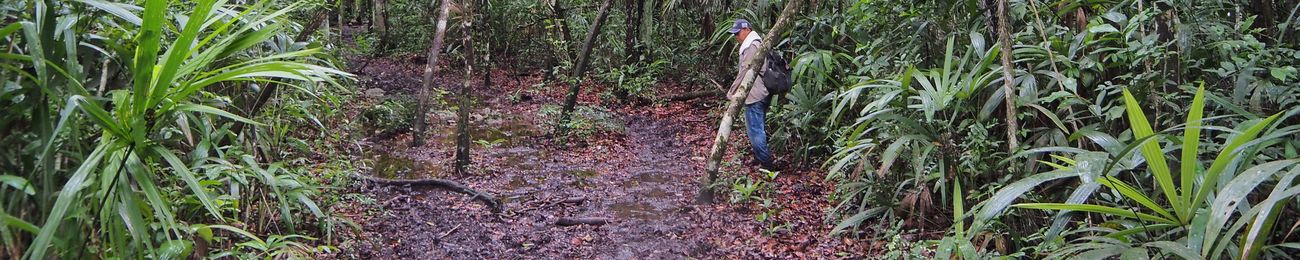
The difficulty of this walk is relative. It mainly depends on the weather. If it rains, the terrain is muddy or even flooded. If it's sunny, it's hot and humid, but above all, mosquitoes come out in squadrons looking for fresh blood... 
 And in fact, at this time of year, we get both at the same time: rain and sun... For now, a blue sky awaits us for 2 days, with, of course, its share of mosquitoes... And we are not all equal when it comes to mosquito bites. As for me, I was not particularly spared; my back, despite the backpack, was covered in them...


We are in a humid tropical forest. The vegetation is dense and tall, reaching for the light high up in the canopy.


El Guacute
After a 2h30 walk. Lunch break at El Guacute, a small "picnic area"...


And we're off again.


El Tintal
Only 1h30 after lunch, we already arrive at El Tintal camp where we will spend our first night.

No running water here; a water reserve supplies the kitchen and makeshift showers.


The hotel rooms! 

Luis unloads our luggage and provisions from the mules. They will stay here next to the camp.

Above our heads, one of the boys living here is busy. With a machete, he prunes a tree. The leaves from the branches falling to the ground will serve as dinner for our mules.


A simple rope was enough for him to climb all the way up! 


Cold shower, of course. It will be a welcome scrub for this first day.


We are not alone here! The place is already under the spell of curious creatures. Metallic colors, a blue head, orange pustules on the face, no doubt! It's your favorite neighbors! They are ocellated turkeys (Meleagris ocellata)!


"It is a large bird, 70 to 90 cm long, weighing 3 kg (female) to 4 kg (male). Both sexes have a blue head with some orange or red warts, more prominent in males. Males also have a fleshy blue crown with warts similar to those on the neck. During the breeding season, this crown develops and takes on brighter and more accentuated colors."
© Wikipedia


Before nightfall, we set off to climb our first Mayan pyramid. Hidden under thick vegetation, it's impossible to find the stone edifice without Luis, who knows the area like the back of his hand. Anyway, there are no mountains in the region! If you find yourself facing a large hill, it's certainly a pyramid hiding underneath! So here we are on the steps of a hill that will lead us to the summit of the El Tintal pyramid.

The ascent takes us past some trees that have taken possession of the edifice over the centuries. But what a surprise when we pass the last steps, it's ecstasy! We are surrounded 360 degrees by a green tropical ocean!

We are just in time to admire the sunset.


Even higher than us, an agave in bloom.

From where we are, it is now easy to spot the large pyramids. The bumps on the flat surface betray their presence.


Back to the kitchen where dinner has already been prepared by Marina.


Tuesday13thNovember
Barely a night has passed, as we get up at 5 AM for breakfast. An opportunity to rediscover our traditional frijoles!


Preparation of the mules and a quick goodbye to the turkeys, whom we will soon see again as the return path will pass through here in 3 days.


As soon as we started our first steps of the day, we surprised a superb toucan in full conversation with, really just beside it, a roadside hawk (Rupornis magnirostris). Alas, the two companions quickly separated, the hawk remaining alone facing my camera...

And off we go for a day of walking under the same conditions as the day before, meaning accompanied by friendly mosquitoes... 


He is discreet but curious enough to show himself from time to time. Also called Geoffroy's spider monkey, it is the spider monkey (Ateles geoffroyi). And if you come across one high up in the trees, pay close attention, where you think you see only one individual, look closely, a second one might be hiding there too... And that's the case in one of the two photos below...! Look closely, it's worth it! 


Oh yes! This little face observing me timidly with its big eyes, I only saw it in the evening on my camera's photo..!
"After mating, the female gives birth to a single offspring after about 225 days of gestation. For 45 days, the baby will cling to its mother's belly, then it will stay on its mother's back for 90 days. It will then gradually emancipate itself under the watchful eye of its mother, who will teach it to feed, for about 1 year. Females reach sexual maturity at 4 years, males at 5 years."
© Wikipedia

This skull, we don't recognize it at first glance, I just hope our 3 mules didn't pay attention to it as they passed by... 


The regular short breaks are always welcome!


Here are 3 beautiful skulls in flesh and bone! 


A mini suspension bridge to remind us of Nepal!

El Zompopero
Another break at El Zompopero. The sign confirms that we are in the "Mirador-Rio Azul" National Park, which is part of the Maya Biosphere Reserve. This reserve covers 21,129 km².


El Jabali
We have been walking for 4 hours when we arrive at El Jabali, a future checkpoint under construction. It's only 11 AM, but we still have lunch here as it was probably planned.


We resume our walk after the small picnic. In 2 hours, we will already reach our final objective, the El Mirador camp!


El Mirador
We walked well, and it's only 2 PM when we arrive at the camp where we will spend two nights. Tomorrow will be entirely dedicated to the archaeological site.


A group is already present since yesterday evening. As for us, it's straight into the hammock to rest our muscles!


And while I'm suspended in my hammock, another one is doing the same, with much more skill than me... And this time, this spider monkey is not accompanied by its clingy offspring.


The camp is larger than El Tintal. This is where a helicopter landing strip is located for the transport of heavy equipment.

Two platforms covered with a tarp will be, like yesterday, our small private rooms.

El Tigre Pyramid
5 PM, the day hasn't fallen yet. This leaves us a little time to begin exploring the site, including the ascent of the El Tigre pyramid.


The Tiger pyramid is 55 meters high. A first staircase leads to a large platform where three other pyramids are located.


And here we are at the top of the 55 meters. Here too, the view is impressive. Trees as far as the eye can see.


Opposite, another pyramid covered by centuries of vegetation peeks out. This is the El Danta pyramid. We will go up there tomorrow.

Oops, a storm is approaching...

Zoom in on the sea of tropical trees.


The highest branches draw white lines on the green canvas of the Mayan biotope...


The approaching heavy storm will quickly bring nightfall. It's time to return to camp!

As expected, by the time we descended, we were in darkness. We put on our headlamps to cover the 400 meters separating us from our igloos. Along the path (nature is well-designed), dozens of small lights mark the sides of the way... Fireflies, I naively thought. To be sure, I approached one of the luminous specimens to observe it closely with my lamp.... And here's what I saw!

 Yes, they are spiders! And it's their eyes that reflect the powerful beam of light projected by my headlamp! Not very reassuring to know that behind each small light hides a small arachnid (presumably from the Lycosidae family) more or less large (1 to 3 cm), but thanks to my lamp, I knew where to walk... They are actually everywhere, including around the tents...
But don't panic, they are not aggressive and tend to stay in the piles of dead leaves...
This will not prevent us from taking a (cold) shower in a small, confined and very spartan place....


Evening dinner.


Then, at the end of the meal, the expected storm arrived as planned, not with light rains, but with real downpours, causing runoff in a few minutes and partly flooding the kitchen... But fortunately, the camp regulars had seen worse and quickly contained the water. Some even took advantage of this sky water to take a shower that ultimately seemed much better than the makeshift one... So it was under the rain that we went to bed. Tomorrow will undoubtedly be wet, and will be dedicated to the continuation of the exploration of the Mayan site.


Latest comments
On Guatemala 2018
Le 25 Novembre 2024
Significado de este mural
On Chile 2016
Le 15 Septembre 2024
Rrrrrr
On Egypt 2003
Le 1er Avril 2023
Et oui c'est bien nous aux pieds de ce Colosse !
Le 1er Avril 2023
Bien petits aux pieds de ce Colosse !
On Namibia 2014
Le 3 Août 2021
very good indeed