


 My blog
  Support me on Tipeee!


Friday12September
Nine o'clock. We are already at one of the Lake Louise parking lots.


And here we are in front of Lake Louise. At the end of the lake, we can see Mount Victoria and its hanging glacier dominating a natural cirque.

On the left, Fairview Mountain. On the right, the peaks of Mounts Whyte, Niblock, and Saint-Piran. All flirt with 3,000 meters of altitude. In the middle, Mount Victoria is at 3,467 meters. 

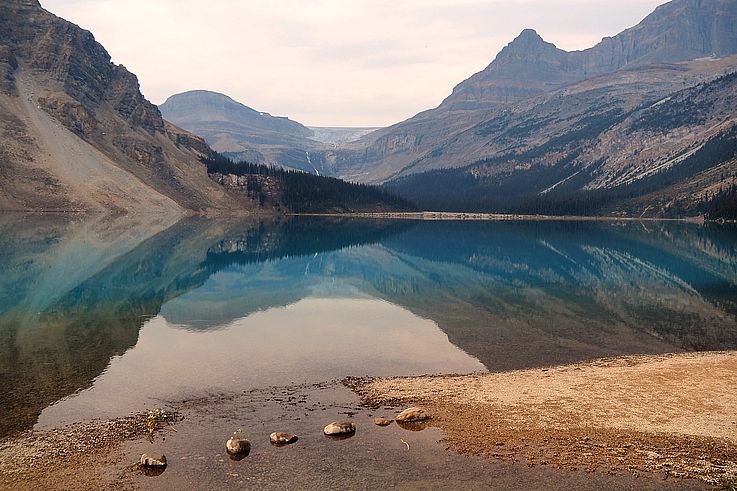
And here, it's a festival of reflections...


Next to the lake, a huge hotel contrasts with the natural setting. It is better to keep your eyes on the lake, otherwise it loses its charm... 


The goal of the day will be to reach way over there, the cirque facing us...

The mountain versus lake landscape is, in any case, magnificent. 


The weather is superb, you just have to press the button to take pretty pictures... 


Before starting the hike, a Swiss mountain guide shows us the way... This bronze statue commemorates the legacy of Swiss mountain guides. From 1899, the Canadian Pacific railway company recruited these alpine experts to accompany visitors in conquering the virgin peaks of the Rockies. Their arrival marked the beginning of the golden age of mountaineering in the region.


And off we go to walk along the lake to its end. Lake Louise, fed by the Victoria Glacier, stretches for a length of about 2 kilometers and a maximum width of about 500 meters. Its maximum depth is 70 meters.


The "castle" hotel that we would have liked better camouflaged and integrated into the surrounding nature...

The Victoria Glacier on its eponymous peak...


The emerald hue of the lake is due to glacial erosion. The glaciers upstream pulverize the rock into a fine powder, called glacial flour, which is then transported by meltwater streams to the basin. It is these suspended mineral particles that diffract sunlight, reflecting mainly blue and green waves to the surface.


And with the colors of the lake, the whole environment also comes to participate in the pretty picture with its touches of color... 


We have arrived at the very end of the lake.

But walking along the lake is only a small part of the day's walk. There are still two hours of walking to reach the final part of the route.


Mount Victoria looks more and more imposing.


Zoom on the seracs of the Victoria Glacier stopped by the dizzying walls of the mountain.


The hiking trail is the Plain of Six Glaciers Trail. 14 kilometers round trip with 500 meters of elevation gain. But we choose to combine the return path with that of the Big Beehive and Lake Louise, which will add 5 kilometers and more elevation gain... 


The little passage where you must not slip...


A simple look back and Lake Louise looks much smaller, nestled between the mountains The Beehive and Fairview.


We arrive at the "Plain of Six Glaciers Teahouse", a stop before the last section of the trail.

Since we are on a roll, we continue our walk and, on the way back, we will have lunch here.


Panoramic view that encompasses Lake Louise on the left and Mount Victoria on the right.


We are approaching the final destination. This big block coming up is Mount Lefroy. It hides the lower part of the Victoria Glacier.


We are on the very last stretch, completely devoid of vegetation. The landscape becomes a mineral universe dominated by the steep walls of Mount Victoria. We are progressing on a moraine, a vestige of the retreat of the ice that carved this deep valley over the millennia.


That's it, we've reached the end! All that's left is to find a little stony corner to settle down and admire the grandiose landscape facing us!


And now, we see the hidden part of the Victoria Glacier which painfully ends its course at the foot of Mounts Lefroy and Victoria.

At the top of the glacier passes the border between the two regions: that of Alberta where we are and that of British Columbia.


Let's go! It's 12:30 and we still have a few hours of walking to finish this hike! So we will have to turn back and we will be able to branch off further on to join the Agnès lake trail.


Lunch break near the tea house. Built in 1924 by Swiss guides on behalf of the Canadian Pacific, the Plain of Six Glaciers teahouse offered a well-deserved rest to the first mountaineers in the region. This rustic stone and wood chalet, accessible only by trails, has been able to preserve its authenticity by continuing to operate without electricity. The provisions necessary for its operation are still transported by horseback or helicopter.


My bag also has the right to a well-deserved rest...


And we're off to start this second half-day. In 4 hours, we will be back at the car! 


The forest that surrounds Lake Louise presents vegetation characteristic of the subalpine zone of the Canadian Rockies. On these steep slopes, the Engelmann spruce and the subalpine fir reign supreme, forming a dark and dense green mantle. Their narrow conical silhouettes are a vital evolutionary adaptation, allowing the branches to shed heavy winter snowfall without breaking.


This is where we leave the path already taken on the way out. This trail will lead us to the neighboring small lake, Lake Agnès. To do this, we must pass through the slopes of The Beehive mountain.


Meltwater transports glacial flour to Lake Louise, those fine particles of crushed rock that will give the lake its turquoise hue.

An imposing scree slope stretches between the wooded hillsides, a witness to the constant fragmentation of rock due to frost.


Here we are at the top of the Beehive.

We are greeted by a golden-mantled ground squirrel (Callospermophilus lateralis). Always so cute... 

The little rodent's attention is entirely focused on the small find at its feet, a mushroom still attached to its clump of earth, which will surely make a change from its usual seeds or pine cones.


Standing on its hind legs, it adopts a characteristic vigilant posture to monitor its surroundings. The gesture of bringing its front paws against its chest helps conserve body heat while remaining ready to seize any food opportunity.


Lake Louise from the top of the big Beehive.

The frail red skiffs carrying their tourists add color to the milky blue of the lake.


And here is the arrival of meltwater into Lake Louise. The torrents pour in their tons of glacial flour, which dilutes into the turquoise expanse. It is this fine suspended rock dust that, through light diffraction, gives the lake its famous emerald hue.


On the other side, Lake Agnes is revealed, nestled in the hollow of another impressive glacial cirque.


Ah, here is a friend of our ground squirrel from earlier, but he is not welcome; a little fight is about to follow... Small but with character!


All that's left is to go all the way down to walk around Lake Agnes.


And hop, here we are down on the shores of Lake Agnes.


Well, a nice surprise! A discreet inhabitant of the high-altitude scree, the American Pika (Ochotona princeps), is perfectly camouflaged in the mineral landscape of the Rockies. This small lagomorph, a cousin of the rabbit, does not hibernate and must therefore build up significant reserves to survive the long Canadian winter. The grass stuck in its little mouth shows it is in the middle of haymaking. All summer long, it harvests alpine grasses and flowers, which it carefully spreads on rock slabs to dry in the sun before storing them. This dehydration process is crucial, as it prevents the fodder from rotting once stored in the depths of the burrow to serve as a winter reserve. 


We've already crossed paths with this one several times; it's the Steller's jay (Cyanocitta stelleri), a familiar host of coniferous forests.


A little further on, the trail passes in front of Mirror Lake, reduced to its simplest form at the end of this summer...

And that's it! We are finally back on the shores of Lake Louise! I must admit that our legs were starting to drag...


Last photo of the day! A good night's rest will be very welcome! Tomorrow, other adventures await us! 

Latest comments
On Guatemala 2018
Le 25 Novembre 2024
Significado de este mural
On Chile 2016
Le 15 Septembre 2024
Rrrrrr
On Egypt 2003
Le 1er Avril 2023
Et oui c'est bien nous aux pieds de ce Colosse !
Le 1er Avril 2023
Bien petits aux pieds de ce Colosse !
On Namibia 2014
Le 3 Août 2021
very good indeed