


 My blog
  Support me on Tipeee!


Saturday6thSeptember
Boulton Creek Campground
This morning, we left Bow Valley campground to get closer to the Kananaskis lakes. So here we are at our new resort, Boulton Creek Campground, located a 5-minute drive from the lakes. Once settled, a quick trip to the campground's restrooms is a must before heading out for the day to tour the lakes. Posters warn, as in most places, to be aware that grizzly and black bears may frequent the campground, as was the case on July 16th when a black bear damaged an unoccupied tent... Safety protocols require securing all odorous products or food remains in airtight containers to prevent interactions with wildlife. It is also strongly advised to carry pepper spray, commonly called "bear spray," a standard precaution for hiking in natural areas...


All trash cans are also secured. You have to push a hidden latch to open the hatches.


Kananaskis village
Before reaching Upper Lake, we make a small detour to Kananaskis Village. Initially designed for the 1988 Olympic Games, this hotel complex surrounded by white spruce forests offers direct access to hiking trails. The beautiful setting also serves as a showcase for major gatherings, such as last June when the village hosted the G7 summit.


We hit the road again and an hour later, it's lunchtime at a picnic area.

Upper Kananaskis Lake
And here we are in front of the star, Kananaskis Lake, the Upper to be more precise, the Lower being a little further just to the right.

Although wild in appearance, Upper Kananaskis Lake is a reservoir whose current physiognomy is the result of human intervention. As early as the 1930s, the Calgary Power company erected dams to raise the level of the original natural lake and power downstream turbines. Today, the site is integrated into Peter Lougheed Provincial Park, created in 1977 to regulate recreational activities in the valley.


As for us, today's recreational activity will be limited to walking to Rawson Lake, a small lake next to the big one. And as sometimes, some trails are closed due to the presence of several grizzlies looking for food...  That doesn't stop us and we decide to brave the prohibition, like the vast majority of hikers present...


The beginning of the walk follows the shores of Upper Kananaskis Lake.


The mountains add majesty to the place. From left to right, Mount Sarrail (2362 meters), Lakeview station (2930 meters), and on the right, Mount Indefatigable (2650 meters).

The "pointed" mountain is Mount Putnik (2940 meters).

Remember to smile when you pass in front of the automatic trigger cameras. Is this monitoring station there to capture images of grizzlies, Ursus arctos horribilis, or of touristus randonarus? 


We cross Sarrail Creek.


Rawson lake
It is here that we turn left to plunge into the pine forest that will lead us to Rawson Lake.


After a 45-minute walk through the forest, we reach our goal for the day, Rawson Lake. We just have to walk along the shore to reach the far end facing us at the foot of the Sarrail cirque.


An inflatable canoe on legs!!! Oh no, among the hikers, some are mainly fishermen and come with their equipment to fully enjoy the lake.


Mount Sarrail culminates at 3174 meters.


The local toilets! 


The bark of this conifer is colonized by symbiotic organisms typical of Alberta's old-growth forests. The brown filaments hanging belong to the genus Bryoria, an important winter food source for some ungulates. They contrast with the fluorescent color of wolf lichen (Letharia vulpina), a toxic species that only grows on dead wood or dry bark. These pollution-sensitive bio-indicators testify to the purity of the atmosphere in the Rawson Lake area.


The Canada Yew (Taxus canadensis). Its flat, pointed needles are toxic, protecting the plant from most herbivores.

A little swim between two sunbeams if you feel like it!!! Not for me anyway , the water surely couldn't have been more than 10 degrees Celsius. 


We are approaching the Sarrail cirque.


Ha! A golden-mantled ground squirrel (Callospermophilus lateralis)! It's always a real treat to observe this curious little rodent, very interested in the comings and goings of passing hikers! 


Perched on the limestone scree, the Ground Squirrel watches for the slightest movement near the trail. This sciurid differs from its cousin the Chipmunk by the complete absence of stripes on its head. Adapted to high-altitude environments, it spends the warm season accumulating energy before entering hibernation at the first signs of cold.


I'm going to gently 'machine-gun' the photogenic rodent who, without knowing it, is filling up my camera's memory card... 


Well, that's all very well, but we have to turn back. Yes, the trail doesn't really go all the way around the lake. So we'll have to do it all over again in reverse!

Fly fishermen, on their floats or on the bank, are in paradise.


"End of trail," indeed, it was truly the end of the path.


Back to the great Upper Lake with Mount Indefatigable opposite. Its name has nothing to do with athletic hikers, but with the Royal Navy battlecruiser HMS Indefatigable. This ship tragically sank with 1019 men on board during the Battle of Jutland in 1916 during the First World War.


Here we are again at the arrival point which was our starting point.


Boulton Creek Campground
Back at Boulton Creek campground. My little two-second tent has more than enough space to stretch out...

For the first time, no barbecue to prepare dinner! Gas cooking for tonight!


And to end the evening, back to Upper Lake to watch the stars rise in the sky.

Sunday7thSeptember
New day in Kananaskis Country. After some shopping in Canmore, the nearest small town, we hit the road again to reach Upper Kananaskis Lake once more.


upper kananaskis lake trail
Yesterday was dedicated to hiking to the small neighboring lake, Rawson Lake. Today, our legs will be dedicated to the large Upper Lake to take us all the way around it...


The Upper Kananaskis lake is the southernmost one; it extends northwards with the elongated Lower Kananaskis lake. The beginning of the trail is the same as yesterday, but instead of turning left into the woods, this time we will stay along the shores of the large lake.


As the sign indicates, this is where the path separates from the Rawson Lake trail.


Close to the ground, bunchberries (Cornus canadensis) or Canadian dogwood offer their berries, edible but not very tasty. It's better to leave them for the bears, who can use them to gain some calories for their winter reserves...


These long brown filaments suspended from conifer branches are arboreal lichens of the genus Bryoria, often nicknamed horsehair. Biological indicators of excellent air quality, they constitute an essential winter food source for cervids in the Kananaskis Valley.


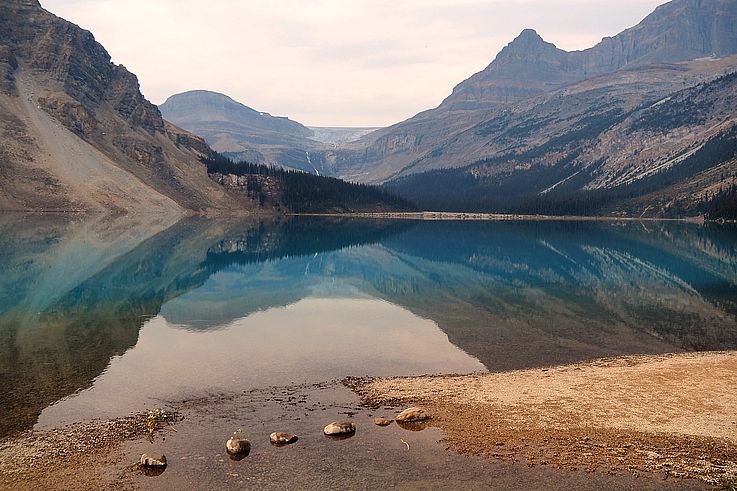
The still waters of Upper Kananaskis Lake are a perfect mirror for the pyramidal silhouette of Mount Indefatigable...


This mushroom with a bright red cap belongs to the genus Russula. It thrives in the humidity of coniferous undergrowth.


Golden resin pearls flow along the grey bark of the Subalpine Fir (Abies lasiocarpa) to heal the tree's wounds. Right next to it, branches suspend lichens (Bryoria), organisms that only thrive in pure air.


A stony creek bed, witness to the meltwater that rushes down the slopes in the spring.

A thick carpet of bryophytes where the stems of Lycopodium (Lycopodium annotinum) emerge.


Red Baneberry (Actaea rubra) is toxic to humans. Toxins act quickly and can cause cardiac arrest. Bears are not sensitive to it, but this berry represents only a small fraction of their late-summer diet.


An Moose! It's far away but my zoom brings me a little closer to one of the emblems of Canadian wildlife. Despite its imposing mass, the moose (Alces alces) is very discreet. We might not have seen it if other walkers hadn't shown it to us. Thank you, because it will be the only one we see on the whole trip! 


In Moose, the distinction between sexes is immediate thanks to the massive, palmate antlers that exclusively adorn the male's head.


The Lakeview Station mountain. Access to this summit is prohibited to hikers to protect the Grizzly habitat.


Along the edges of the trail, the ground sometimes disappears under a thick mantle of Schreber's moss (Pleurozium schreberi). This plant carpet retains the moisture necessary for the development of discreet ground cover plants like the five-leaved bramble (Rubus pedatus).

This spruce trunk bears the marks of the intense activity of the Pileated Woodpecker (Dryocopus pileatus). In search of ants and wood-boring larvae, this bird digs characteristic deep rectangular excavations. These wounds inflicted on dead wood play an ecological role by creating niches for other species in the valley.


We are at the western end of the lake. You have to go deep into the forest to cross the rivers that join the lake.


Oh, a Steller's Jay (Cyanocitta stelleri)! Its blue plumage and black crest are unmistakable. This corvid is often observed near water points where it searches for seeds or insects.


It is the avian emblem of the neighboring province of British Columbia.


This trunk reveals the hidden activity of wood-boring insects. Under the bark that peels off in flakes, one can distinguish the sinuous galleries dug by wood-boring larvae.


The area becomes marshy in places.


This ester is visited not by a bee but by a drone fly (Eristales tenax), a fly that thus avoids predators who would confuse it with the stinging insect...


The Upper Kananaskis River.


The summit of Lake View Station.

This will be perfect for lunch. Also an opportunity to refill our Grayl water bottles, which have a built-in filter making the water immediately potable.


With full stomachs, we resume the hiking trail. Autumn colors are already present in this meadow bordering Upper Lake.


The setting is perfectly suited for fly fishing.


Perched on a rock, this black longhorn beetle (Monochamus scutellatus) is about to take flight. This beetle, typical of coniferous forests, is recognizable by its disproportionately long ringed antennae and the white spot at the base of its wings, the scutellum.

Far from everything, the small "Point Campground" without running water or electricity, is located just behind this small pond. You will need to obtain a special backcountry permit to stay there.


We are now on the north shore of the lake.


An American Pika!!! Ochotona princeps. It stands motionless in front of the entrance to its burrow! This small cousin of the hare is a tireless worker who tirelessly stores dried grasses to survive during the snowy months.

The trail crosses a mineral alluvial fan at the foot of limestone and dolomite cliffs. The horizontal lines traced in the rock correspond to ancient sedimentary layers uplifted during the orogeny of the Rockies. A few specimens of spruce (Picea) and subalpine fir (Abies lasiocarpa) still manage to root in this poor soil.


Freeze-thaw cycles cause the geological phenomenon of frost shattering. Water infiltrates the cracks in the limestone walls then freezes, breaking the rock into fragments of various sizes. These debris then fall and accumulate by gravity to form an alluvial fan at the base of the slopes.


The Lakeview Station and its 2930 meters.


The Sarrail Ridge with the peaks of Mounts Foch and Sarrail behind it.


Little squirrel, you who play the fool,
I see your eye when you come to us,
Little squirrel, you who play the fool,
I see your eye when you come to us.
I see your plume
And your mischievous eyes.
You play hide-and-seek
Around the old trunk...
This nursery rhyme from my childhood inevitably comes to mind when this squirrel appears! And I will hum it regularly throughout the trip as the little forest rodent will regularly show itself... This is an American red squirrel (Tamiasciurus hudsonicus).


The lake tour continues and we reach the end of the north shore.


And here is Lower Kananaskis Lake! It has not usurped its name, it is much lower than the Upper lake...

A commemorative plaque recalls the origin of the name of Mount Putnik in Kananaskis Country. This peak was named in 1918 in homage to Serbian Field Marshal Radomir Putnik to highlight the alliance between Canada and Serbia during the First World War.


The rest of the hike will be on asphalt, as the woods separating us from the arrival point are forbidden, due to bears in the vicinity... 

And here we are back at Boulton Creek Campground for aperitifs . Just like in Namibia and South Africa, it will often be accompanied by dried meats  . For tonight, it will be beef.

Before night falls, we return to Upper Lake for the sunset.


The sun has set. It will soon be our turn too. Tomorrow, we leave Kananaskis to reach the next stage of our road trip, the town of Banff.


Latest comments
On Guatemala 2018
Le 25 Novembre 2024
Significado de este mural
On Chile 2016
Le 15 Septembre 2024
Rrrrrr
On Egypt 2003
Le 1er Avril 2023
Et oui c'est bien nous aux pieds de ce Colosse !
Le 1er Avril 2023
Bien petits aux pieds de ce Colosse !
On Namibia 2014
Le 3 Août 2021
very good indeed