


 My blog
  Support me on Tipeee!


Sunday14thSeptember
We are leaving the Banff region to join the Jasper region, 230 kilometers and 3 hours away. The road is almost straight; it's the "Glacier Promenade," or "Icefields Parkway," which winds through high mountain landscapes classified as a UNESCO World Heritage site. Over the kilometers, we will be able to enjoy the various viewpoints, each as superb as the next. 


Bow lake
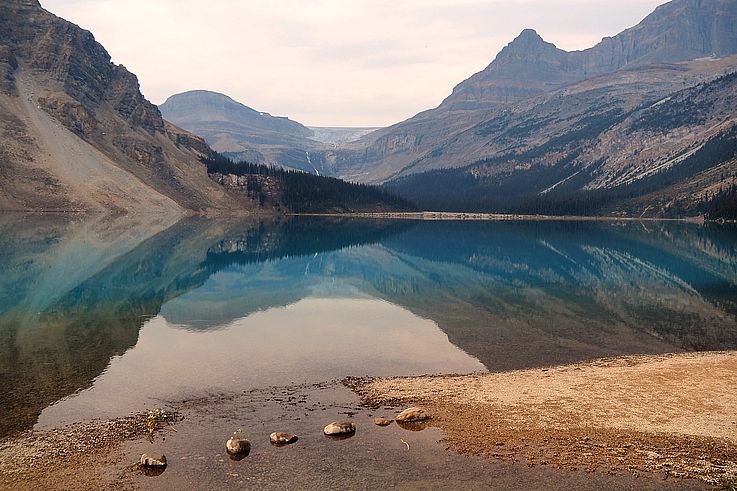
First stop at Bow Lake. It is the source of the river of the same name that we have often crossed. Its crystal-clear waters are fed by the Bow glacier.


The peaks of the Crowfoot range plunge superbly into the lake's waters. We are at an altitude of 1930 meters!


We get back in the car to reach another parking lot north of the lake, a little further on.

The Crowfoot glacier.


The morning atmosphere, mixed with the colors of autumn, enhances the beauty of the site.


The lake lodge.


It's beautiful, it's beautiful, it's beautiful!


The water mirror transforms the colors... glasses.gif

The Bow glacier. Perched on the limestone cliffs overlooking Bow Lake, the Bow glacier is only a fraction of the vast Wapta icefield that once covered the region. Since its maximum reached at the end of the Little Ice Age around 1850, it has undergone a spectacular retreat, giving birth to the waterfalls that feed the basin below.


Peyto Lake
New stop 6 kilometers further, at Peyto Lake. The viewpoint offers a plunging view of the lake and its turquoise hue. If you look closely, the basin draws the shape of a wolf's head standing out against the dark green of the coniferous forests. yes.gif glasses.gif

Caldron Peak mountain grazes the wolf's back. wink.gif


The Peyto glacier, today's ghost versus the one from 1902...


The whitebark pine, Pinus albicaulis, is a sentinel species whose survival is threatened here in the Canadian Rockies.


Mistaya canyon
Next stop at Mistaya Canyon, 30 kilometers from Peyto Lake.

The name of the Mistaya canyon and its eponymous river draws its origins from the Cree language, where it means "grizzly", thus evoking the indomitable power of the torrent. Over the millennia, the tumultuous waters laden with abrasive sediments have tirelessly sculpted the limestone rock to create these walls with spectacular curves.


In the background, Mount Sarbach and its glaciers.


And off we go, not in a red Mustang but still with our Grand Cherokee Jeep... doubt.gif Heading to the Athabasca glacier, 55 kilometers further.

The Athabasca glacier
Car left in the parking lot, we walk the access path to the Athabasca glacier which winds through a chaos of gray rocks and sediments abandoned by the ice. This moraine landscape, stripped of all vegetation, testifies to the constant retreat of the Columbia icefield since the mid-19th century.


This chronological marker indicates the location of the ice front in 1992, 500 meters from its current position.


Guided tours are possible on the glacier, but we are just passing through and Iceland had already satisfied us in terms of walking on ice. wink.gif


Right next to the glacier, Sunwapta Lake, a proglacial basin born from melting ice, marks the area that Athabasca still occupied a few decades ago.


Before hitting the road again, I take the opportunity to fill my Grayl filtering water bottle. The filter will have a lot of work to do to remove the glacial flour, those fine particles of rock in suspension coming from the glacier. yes.gif

Athabasca Falls
70 kilometers further, here we are in front of the Athabasca Falls, a direct extension of the Columbia icefield. They are fed by the Athabasca River, whose tumultuous waters are born from the melting of the eponymous glacier. This boiling current, laden with abrasive sediments, has patiently carved a narrow canyon into the rock.


The water of the Athabasca River falls about twenty-three meters.


In the distance, Mount Kerkeslin (2984 meters).


The site bears the scars of a past fire, a natural phenomenon paradoxically essential to the health of the Rockies' ecosystems. The charred trunks and the ash-covered soil offer a fertile ground rich in nutrients for the vegetation that is recolonizing the space.


Crossing to the other side.


The devastating fire that hit the Jasper region started on July 22, 2024. This complex of forest fires swept through the valley, leaving behind thousands of hectares of charred vegetation. Some areas remain closed to the public.


Last look at the Athabasca River before getting back in the car and heading to the small town of Jasper and its Wapiti campground 30 kilometers away.

Wapiti Campground
The Jasper campground did not escape the July 2024 fires. A year later, only the grass has grown back between the charred trunks. We are therefore far from the cozy atmosphere of bivouacs in the middle of pines and thieving squirrels. Here, we are all together in one giant enclosure, in the end it doesn't change much about our little camper life! giggle.gif


And for our first evening in Jasper, we try one of the emblems of popular Canadian gastronomy: poutine! This "dish" traditionally consists of fries and cheese curds, all topped with a smooth brown gravy. Although its origins are in Quebec, this specialty has become a must-have for alpine stops in Alberta, especially for its energy intake after hard hikes in the Rockies... giggle.gif By the way, tomorrow, hikes await us around Jasper!

Latest comments
On Guatemala 2018
Le 25 Novembre 2024
Significado de este mural
On Chile 2016
Le 15 Septembre 2024
Rrrrrr
On Egypt 2003
Le 1er Avril 2023
Et oui c'est bien nous aux pieds de ce Colosse !
Le 1er Avril 2023
Bien petits aux pieds de ce Colosse !
On Namibia 2014
Le 3 Août 2021
very good indeed