


 My blog
  Support me on Tipeee!




Saturday16November
This new day begins with the Aljunied metro station, with its raised tubular structure.


The Supreme Court of Singapore with its disc-shaped upper structure housing the courtrooms. 

The Elgin bridge, from 1929, spans the Singapore river. It replaced several wooden and iron bridges that succeeded one another at this location since the early 19th century.


The quays of Clarke Quay.

The shophouses of Clarke Quay display bright colors under large futuristic glass roofs. These canopies, supported by steel pillars, are designed to cool the atmosphere by channeling air currents and protecting from the tropical sun.


Now, we put on our real tourist clothes and embark on a boat to tour the bay... Navigation is aboard a bumboat, modernized traditional boat.


On the left, the dome of "Theatres on the Bay" is covered with thousands of aluminum sunshades, giving it the appearance of a durian.

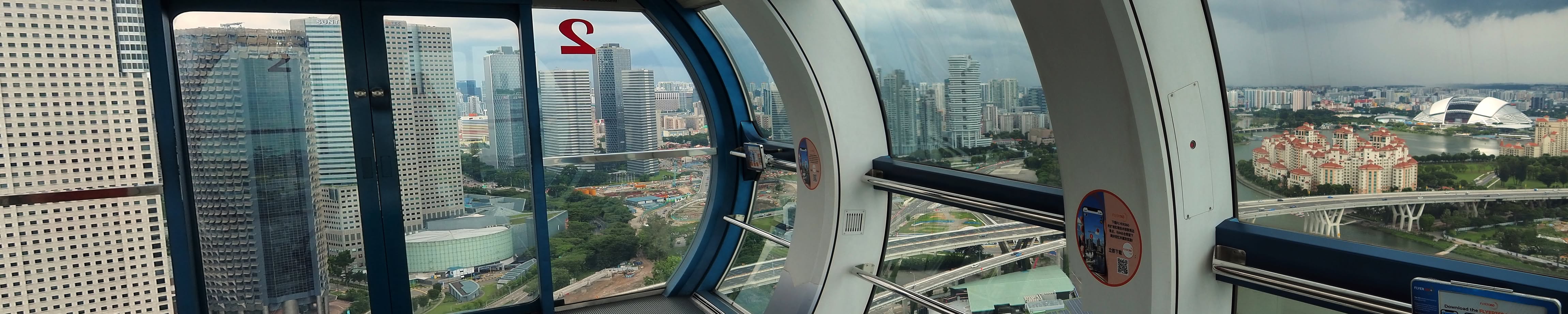
Marina Bay and three of its iconic buildings: The Marina Bay Sands hotel complex, with its three towers linked by the Skypark. At its feet, the ArtScience Museum and its lotus flower structure. And the Singapore Flyer Ferris wheel.

In two days, we will be all the way up on the SkyPark!


The Sands SkyPark is suspended 200 meters high, on the 57th floor. The bridge extends nearly 67 meters over the void.


At the foot of the three hotel towers, a spherical glass pavilion tries to compete. It is the Apple Store, made up of 114 glass panels.


The statue of the Merlion, with its fish body and lion head spitting water continuously.


Singapore's central business district, symbol of the city-state with its concentration of skyscrapers, many of which are built on land reclaimed from the sea.


Seen from the river, the underside of the Esplanade Bridge.


Here we are back on dry land.


The UOB Plaza One tower and the OCBC Centre.


The historic shophouses of Boat Quay line the Singapore River. These two or three-story buildings, with their terracotta tile roofs, were the heart of commercial activity in the 19th century. The ground floor served as a warehouse or shop, while the upper floor was residential. Today, these structures have been restored and mainly house restaurants.


The CapitaSpring tower tears its vertical envelope to reveal terraced gardens.


The Cavenagh Bridge, the oldest bridge in Singapore to retain its original form, was assembled in 1869. It faces the Fullerton Hotel, a neoclassical building and former general post office. The hotel is now classified as a national monument.

Bronze sculptures by artist Chern Lian Shan, part of the People of the River series. They immortalize a scene from the city's commercial past. Titled A Great Emporium, the work depicts merchants from different 19th century communities weighing goods before loading them onto boats.;


The sculpture From Chettiars to Financiers illustrates the transition of Singapore's financial sector over time. The work juxtaposes the figures of an Indian pawnbroker (chettiar) and a Chinese accountant with his abacus, with that of a modern businesswoman.


In the park of the Asian Civilisations Museum, the installation 24 Hours in Singapore is a work by sculptor Baet Yeok Kuan. You can see one of the rare selfies of yours truly  . And if you pass by, remember to put your ears on these globes, you will hear sounds of daily Singaporean life integrated inside.


Verticality of architectures with the Maybank towers and its blue facets, and the Bank of China tower.


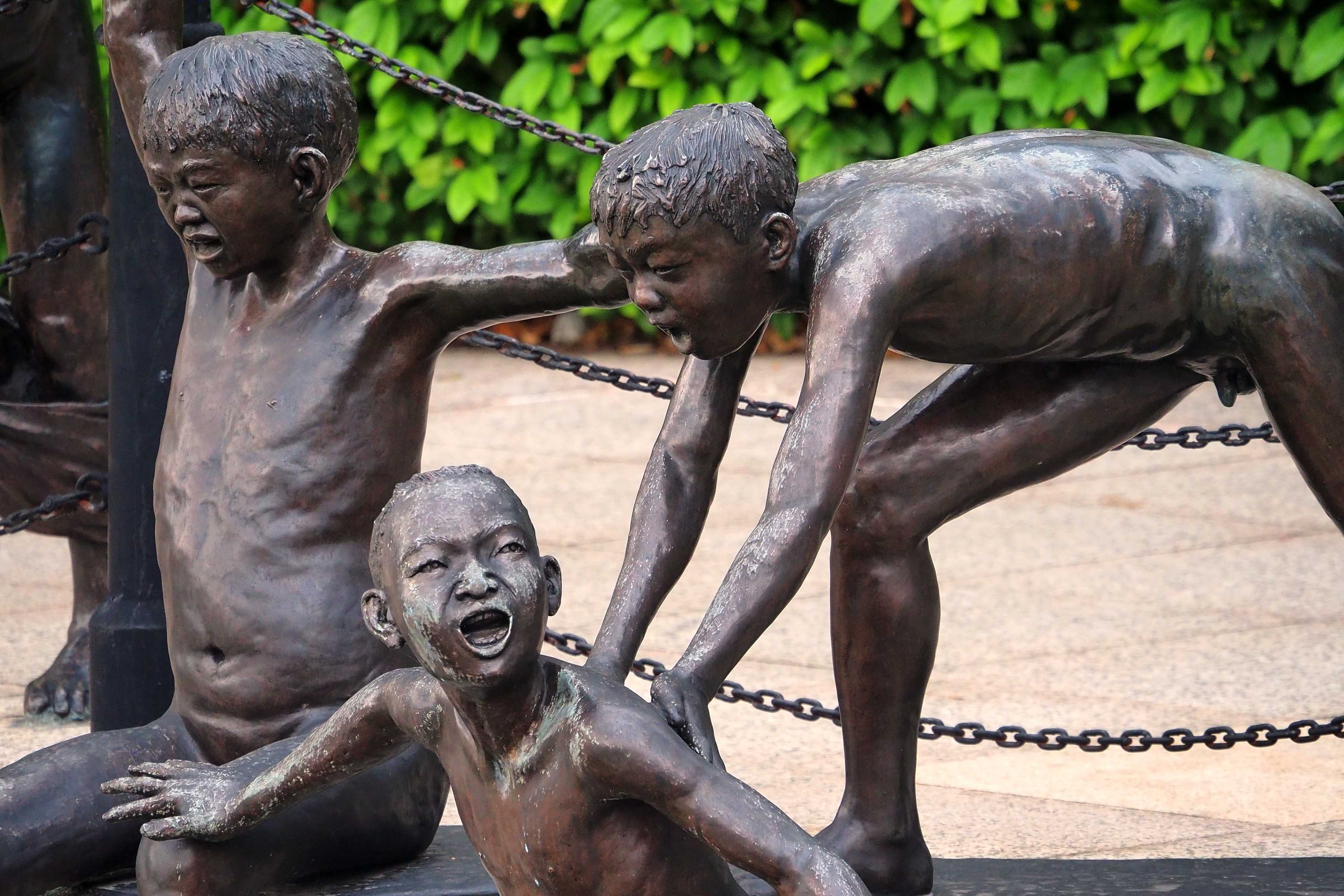
With "The First Generation", artist Chong Fah Cheong evokes the games of the children of the first immigrants who bathed in the stream.




The UOB Plaza Two tower, built in 1973, stands like a glass and steel monolith amidst historical heritage.

Another work by Chong Fah Cheong.


Lunch at the restaurant Harry's boat quay.


The old Supreme Court, British colonial heritage. Behind, the modern towers of the business center rise, notably the cylindrical silhouette of the Swissôtel The Stamford.

National Museum of Singapore
After the walk in the fresh air, we will lock ourselves for a short time in the National Museum. The latter is dedicated to the history and culture of the city-state, from the first kingdoms to the colonial period, to independence and the contemporary development of Singapore.


Inside the museum, the galleries explore the multiple facets of the Singaporean population through the ages. One finds notably, the portrait of Wong Ah Fook, Chinese entrepreneur and philanthropist. By his side, that of Sir Harry St. George Ord, first governor of the Straits Settlements, represents British colonial power. These portraits of the elite contrast with scenes from the life of workers, as shown in this photograph of an opium den, a widespread social scourge at the time.


After the museum, a short tour through the historic complex of CHIJMES where the former chapel of the Convent of the Holy Infant Jesus is located. Classified as a national monument, this converted place of worship is today a commercial and event space. 


The Raffles Hotel, inaugurated in 1887, is classified as a national monument.

At the foot of the two towers designed by the agency Foster Partners, one finds restored old military buildings, such as the NCO Club. The new skyscrapers are characterized by a wavy canopy designed to create a cooler microclimate.

Civilian War Memorial
Erected in the heart of War Memorial Park, this monument is a tribute to the civilian victims of the Japanese occupation of Singapore. Its four slender pillars, nearly 70 meters high, symbolize the four main communities of the city-state: Chinese, Malay, Indian and Eurasian. This concrete structure is soberly nicknamed "The Chopsticks" by the locals!


The Civilian War Memorial was gazetted as a national monument on August 15, 2013. The four tapered columns of 61 meters symbolize the common experiences during the war and the unity of the main ethnic groups of Singapore.


In the heart of the Suntec City complex is the Fountain of Wealth, recorded in 1998 as the largest in the world by the Guinness Book of Records. Built in bronze, its design is based on the principles of Feng Shui. The water flowing inwards is a symbol of wealth and life. The large ring represents a mandala, a symbol of unity and perfection in Hindu culture.


Chinatown
Back to the Chinese district.


The practice of ancestor worship is visible in the heart of Singaporean urban life. Metal braziers are arranged on the sidewalks for the safe burning of offering paper, or "joss paper". This ritual, derived from Chinese Taoist and Buddhist traditions, consists of sending symbolic goods, such as money or everyday paper objects, to the spirits of the deceased.


Dinner at Chinatown Complex Food with Peranakan specialties such as Popiah, a spring roll, and Kueh Pie Tee, a small crispy tartlet garnished with sliced vegetables.


Safari Night
And for today, after dinner, no rest!!! And for once, we are going to do a zoo but at night! We are at the "Night Safari" in Singapore which is the first nocturnal zoological park in the world . Opened in 1994, it offers an immersion into the habitat of more than one hundred animal species active after sunset. The park uses special lighting, simulating moonlight, so as not to disturb the animals and allow their observation.

Sometimes we barely distinguish the animals. Here, a Sunda pangolin (Manis javanica), nocturnal and solitary mammal. Its body is covered with keratin scales, the same material as human nails, serve as armor. When threatened, it curls up into a ball, forming an almost impenetrable ball. As for the Buffy Fish Owl (Ketupa ketupu), also known as the Malay fish owl, is a nocturnal raptor emblematic of the wetlands of Southeast Asia.


Short show in an open-air amphitheater.


The aardvark (Orycteropus afer), whose name means "earth pig" in Afrikaans, is a nocturnal mammal native to Africa. It is the only living representative of the order Tubulidentata. Its claws are an effective tool for ripping open termite mounds, its main source of food. The animal uses its long snout and keen hearing to locate insects in the dark.

The Malayan tiger (Panthera tigris jacksoni) is one of the residents of the Night Safari.


A crested gecko (Correlophus ciliatus), species endemic to New Caledonia, thought to be extinct until its rediscovery in 1994. This reptile has no eyelids, it uses its tongue to moisten and clean its eyes. As for me, I have eyelids and they are going to close, time for a taxi to take us back home! Tomorrow, a lot of activity still awaits us which will fill the day well!

Latest comments
On Guatemala 2018
Le 25 Novembre 2024
Significado de este mural
On Chile 2016
Le 15 Septembre 2024
Rrrrrr
On Egypt 2003
Le 1er Avril 2023
Et oui c'est bien nous aux pieds de ce Colosse !
Le 1er Avril 2023
Bien petits aux pieds de ce Colosse !
On Namibia 2014
Le 3 Août 2021
very good indeed