


 My blog




Tuesday19November
Last day of our Singaporean week (not counting the previous three Malaysian weeks)! On the day's program, the Little India district!


We are in the period of Deepavali, the Hindu festival of lights. Monumental arches are installed in the streets, marking the entrance to the festivity zones.


Serangoon Road, the main artery of the Little India district. The "five-foot way", these covered passages at sidewalk level, offer shelter against the sun and bad weather. The "five-foot way" was imposed in the 19th century by Sir Stamford Raffles to create a sheltered sidewalk with a minimum width of five feet (1.5 meters), hence its name. 


Traditionally, the ground floor housed a business while the floor served as a residence.


Tekka centre
We enter the Tekka Centre, emblematic complex of Little India which houses a large fresh produce market, or "wet market".


The stalls are full of diverse and varied vegetables... Indian gooseberries (Phyllanthus emblica), also called amla. Okra (Abelmoschus esculentus) and pointed gourds (Trichosanthes dioica).


Limes and custard apples (Annona squamosa).


Green mangoes (Mangifera indica). Long moringa sticks (Moringa oleifera), or "drumsticks". Guavas (Psidium guajava).


Eggplants (Solanum melongena), pomegranates (Punica granatum) and cassava tubers (Manihot esculenta).


Bitter melons (Momordica charantia) and ivy gourds (Coccinia grandis).


The stalls are full of fresh produce, but not only, altars dedicated to various Gods always have a small reserved place.

Vendors assemble garlands, or "maalai", used as offerings in Hindu temples. These compositions are often made of roses, marigolds or jasmine, meticulously braided for religious rituals.


Buckets overflow with areca nuts (Areca catechu) and dried chillies.


Areca nuts (Areca catechu).


Sri Veeramakaliamman Temple
The Sri Veeramakaliamman temple, one of the oldest Hindu shrines in Singapore.

Before entering the main prayer hall, you must take off your shoes. The sanctuary is dedicated to the goddess Kali.


This golden sculpture represents Shiva Nataraja, the "Lord of the Dance", in the execution of his cosmic dance, the Tandava. Under his right foot, he masters Apasmara, a demonic figure symbolizing ignorance. According to Hindu tradition, Apasmara must not be killed, so that knowledge retains its value. Shiva thus maintains this form eternally to contain ignorance.


The statue of the goddess Kali with a bull's head at her feet is submerged in petals, a gesture of veneration in Hinduism.


Saraswati, the goddess of knowledge, music and the arts. She is represented here in her traditional form, playing the veena, a string instrument of Indian classical music.

A priest, or pujari, wearing a traditional dhoti. The white marks on his body are vibhuti, sacred ash used in religious ceremonies.


The gopuram, or gate tower, is an architectural element of Dravidian-style Hindu temples. This pyramidal structure is richly decorated with polychrome sculptures representing a pantheon of deities and mythological figures. On the first level, one can see the goddess Draupadi surrounded by flames, known for the fire-walking ritual.


These niches allow the faithful to deposit individual offerings to deities. Represented here are Sri Narasimhar, the man-lion avatar of Vishnu, and Sri Bramha Sastha.


A Brahmin priest collects offerings from the faithful. Here, milk in cartons is offered, intended for abhishekam, the ritual bathing of deity statues.


Upon leaving the temple, the faithful ring the bells attached to the heavy wooden doors. This ritual gesture serves to take leave of the deities present in the sanctuary. The sound of the bell is also perceived as a means to purify the mind and ward off negative energies before returning to the outside world.


Meditation in front of the silver altar adorned with an effigy of Ganesha, the god who removes obstacles.


Tekka centre
Return to the Tekka Centre for lunch in one of the many stalls. In 2020, this culture of "hawker centers" was inscribed on the UNESCO Representative List of the Intangible Cultural Heritage of Humanity.


There are not only restaurants here. The Tekka Centre also houses a large fresh produce market.


Pitayas, or dragon fruits (Hylocereus undatus).


The floor is reserved for non-food items.


The House of Tan Teng Niah is one of the last Chinese villas remaining in the Little India district. Built in 1900, its structure presents a fusion of European and Southern Chinese architectural elements. The bright colors that adorn its facade today were added during a restoration.


Indian Heritage Centre
Visit to the Indian Heritage Centre museum, dedicated to the culture of the Indian communities of Singapore.


These frescoes by artist Navin Rawanchaikul, presented during the "Once Upon a Time in Little India" exhibition. These drawings mix historical archives with contemporary portraits of the inhabitants and merchants of the district.


We had spotted it four days ago, bakkwa, a specialty of dried and grilled pork meat. The meat is marinated in a mixture of sugar and spices, which gives it a sweet and salty flavor. The thin sheets are then grilled over charcoal, hence their lacquered appearance and slightly charred edges. 


Marina Bay
Back to Marina Bay to end the day before heading to the airport! The sculpture "Soul", by Catalan artist Jaume Plensa, is installed in front of the Ocean Financial Centre. This human figure is composed of a lattice of stainless steel characters. The letters come from the four official languages of Singapore: Chinese, Malay, Tamil and Latin.


It's a little reminder of our first day in Singapore with this smooth-coated otter (Lutrogale perspicillata) that we may have already crossed in the Botanic Garden. These social mammals have adapted to the urban environment, forming families that are followed by the inhabitants.



Christmas on the balcony, Easter at the embers! 


Another discreet selfie! 


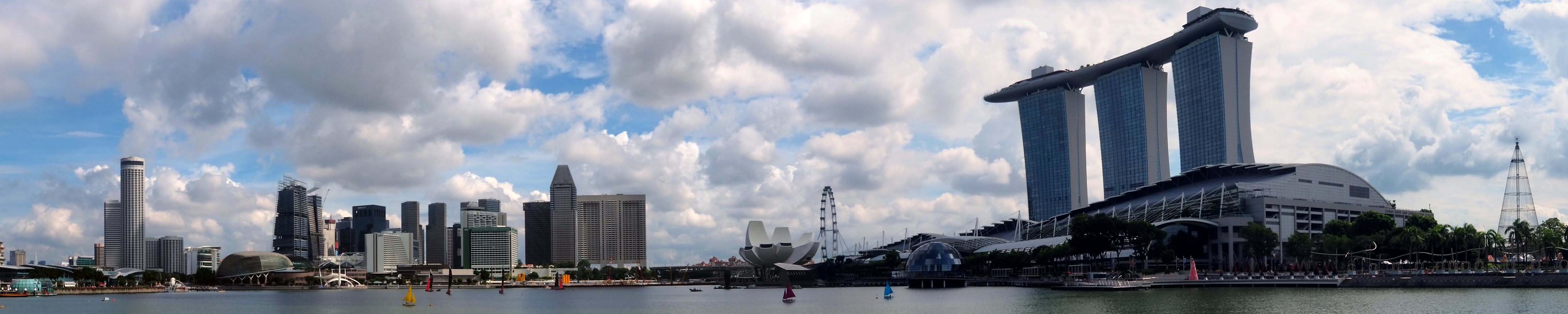
It was the architect Moshe Safdie who designed these two buildings. The ArtScience Museum, which evokes a lotus flower, and in the background, the towers of the Marina Bay Sands supporting the immense SkyPark.


In the basin of the ArtScience Museum, a tropical water lily (Nymphaea colorata) and its purple flower try to compete with the immense artificial lotus overlooking them.


Return to the shopping center The Shoppes at Marina Bay Sands.

In the gallery, the installation "Digital Light Canvas" consists of a 14-meter suspended light sculpture and an interactive LED floor. Schools of digital fish evolve on the floor, reacting to the movements of visitors while the light sculpture synchronizes with the animation... 


And it is on these digital fish that the four-week journey ends, from Malaysia to Singapore! There is still much to discover, especially the western part of Malaysia with Borneo. So maybe see you soon in the area! 


Latest comments
On Guatemala 2018
Le 25 Novembre 2024
Significado de este mural
On Chile 2016
Le 15 Septembre 2024
Rrrrrr
On Egypt 2003
Le 1er Avril 2023
Et oui c'est bien nous aux pieds de ce Colosse !
Le 1er Avril 2023
Bien petits aux pieds de ce Colosse !
On Namibia 2014
Le 3 Août 2021
very good indeed