


 My blog




Tuesday19November
We leave Chikuma to continue our ascent north. Today, we reach the small town of Sagata, but originally, this stage was only supposed to be reached the next day... The primary objective was to take a small excursion to the Jigokudani Monkey Park... But not everything went as planned... doubt.gif


Yamanouchi
So here we are in the town of Yamanouchi, from where you can access the famous Jigokudani Monkey Park.


The Kamuka River
I make a 180-degree turn and find myself facing the Yomase River. The two rivers meet exactly here.


Jigokudani Park is famous for its macaques bathing in hot springs, much to the delight of tourist photographers... As for us, we won't see a single one... The primates, fond of onsen, are in their mating phase and have retreated deep into the forest. A little disappointed at first not to be able to observe this small community of macaques, the disappointment was then replaced by relief. Indeed, after finding a little more info about the park, it turns out that it is partly artificial... The main pool that hosts the monkeys was built by man in 1967, and the monkeys are fed to attract them into the water... huh.gif It is therefore without regret that we decide to get ahead of our itinerary by reaching the next stop, Sagata, which is 5 hours away by car, today.
Niigata
Lunch break will be in the city of Niigata at the Kura sushi restaurant, where service is via conveyor belt. Everything is done remotely! Dishes are chosen on the touch screen, which quickly triggers the arrival of the requested dish on the upper belt. If you're lazy, you can simply take one of the plates that pass by on the lower belt... At the end of the meal, the waitress will count the consumed plates and, according to their colors or designs, will determine the total amount... yes.gif

Our few chosen dishes. yes.gif

On the right, the dessert warabimoshi kinako: sticky rice covered with roasted soybean powder. We'll need at least all that to finish the 3 hours of driving we have left to reach Sakata!


Wednesday20November
Tsuruoka
It's already the next day, early in the morning, from our hotel window, not in Sakata but in Tsuruoka, one of the neighboring cities.

The road from the previous evening often ran along the west coast. The wind was blowing hard and literally unleashing the sea. So we decide to go see if the spectacle is still as beautiful in broad daylight... We stumble upon a beautiful spot surrounded by wind turbines. And indeed, we are right in front of the power plant which is protected from the sea by a dike where the waves crash. The wind is blowing very hard but the spectacle is superb!


The dike is not there for nothing; in Japan, tsunamis are not fiction... We all remember the one that devastated the East coast in 2011.


A little slow-motion of the storm...
5 wind turbines are placed along the dike, 4 others on the beach, and about ten more 3 kilometers further. Wind power accounts for 1% of electricity production in Japan (in France it is about 6%).


Clouds are gathering and the light adds a bit of drama to the scene. wink.gif


Shimohie Shrine
Alright, no more fooling around with big waves! Our mission for the day is completely different! After watching a report on Arte a few months earlier, I set my mind on finding a Buddhist monk... To be more precise, a mummified Buddhist monk who died 233 years ago... In my research to locate the place where the famous monk "resides", I found three others no more alive but located not too far from each other... So here we are in front of Kaikoji Temple, housing two of these mummies under its roof... glasses.gif

Once past the "sanmon" of Kaikoji Shrine, the place seems quite deserted...


We approach the temple and still no one...

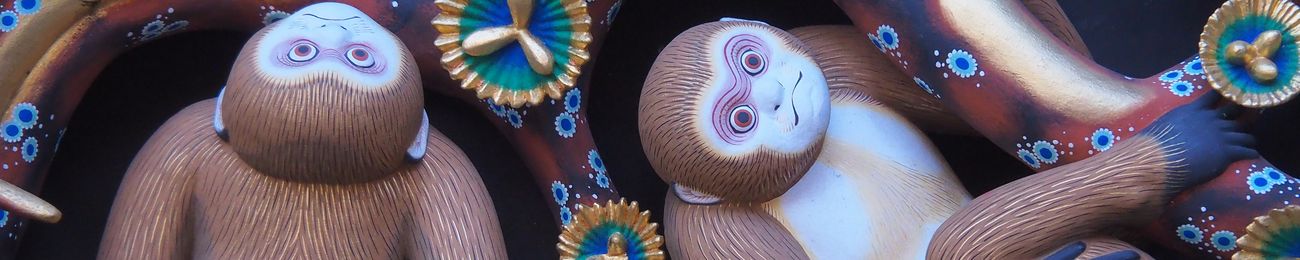
The monkeys clinging under the roof look more like mummies than our primate cousins... Is this a sign that we are in the right place?...


The door is closed. Inside, no more people than outside...

So we drew a blank on our first attempt... But after checking, they were indeed present in this sanctuary, but we were probably not in front of the right building... sorry.gif

Kaikoji Temple is located a bit higher up with a view of Sakata city
Tsuruoka - Churen Ji Temple
Second attempt! We move on to the small neighboring town: Tsuruoka. And more precisely to Churen-ji Temple, which is a bit isolated in the beautiful countryside where snow is slowly beginning to cover the ground... The temple is located on top of a small hill, let's hope the car can climb the roads and especially let's hope we can get back down...! doubt.gif


The temple seems to be under renovation, but this time, there are people! You even have to make a small "financial" offering giggle.gif to be able to enter the temple.


The interior is sober apart from a small generously decorated room.

In a small corner, there he is, sitting on an altar behind a glass. His name is Tetsumonkai Shonin. He was born in Tsuruoka in 1768 and died there in 1829 at the age of 61. Yes, it is indeed his body that has been there for almost 200 years. Mummified, then. Mummified yes, but not as we usually understand it. Mummified according to the practice of sokushinbutsu. The monk did not have his organs removed and his body embalmed after his death. No, that's not what happened... After his death, he was left "as is" and it was time that mummified the monk. While this phenomenon sometimes occurs naturally, it is on the contrary the sokushinbutsu himself who decides during his lifetime to make his body "immortal"... But let's move on to the next temple to learn more about this practice!

Tsuruoka - Ryusuiji Dainichibou Temple
And here we are 10 minutes later in front of the last temple of the three we spotted. The snow has intensified, don't forget that we are at the northernmost point of our loop on Honshu Island! It's not the far north, but winter is approaching and is very present... Let's hope our little wanderings around the monks won't prevent us from leaving the region, because we have to start our descent south today...

In the porch leading to the temple, waraji sandals.
"In ancient Japan, waraji were the footwear of the common people. Firmly secured to the foot, drying quickly, they allowed walking in rice paddies. Due to their low cost and durability, they were also appreciated by Buddhist monks and samurai who had to travel long distances on foot. There were also models for horses. Today, they are hardly worn except by monks."
© Wikipedia


Like the previous one, the temple is under renovation. Let's hope it's not closed!


Several centuries have worn the wood of this temple. Dainichibou Temple was founded in the year 807! And the temple is not empty; monks are there to receive passing visitors!


After taking out some Yen, we enter and remain alone for a few minutes in the large room of the temple... No mummified monks in sight...

Suddenly, a monk asks us to kneel facing the altar. Obviously, we comply but we wonder what sauce we are going to be eaten with... Then the monk grabs a large pole with long white strips at its end, then "purifies our minds" remotely with the tip of his lance by passing and re-passing the white ribbons over our heads. A wifi blessing of sorts...  We don't understand much except that we must participate in this little ceremony to have the honor of presenting ourselves before Shinnyokai-Shonin the sokushinbutsu monk. The monk, after putting down his large lance, then slipped away behind the grilles of the small room... Then coming out of nowhere, an impressive sequence of percussion began to resonate in the temple. Just us alone under this centuries-old roof...
After an imposing silence, a young girl comes to kneel beside us... Phew, finally someone will tell us what's going on! giggle.gif And indeed, the young girl tells us in English the history of the place and then invites us to follow her to see Shinnyokai-Shonin...

And here we are in front of the Sokushinbutsu which simply means "mummified monk" but can also be translated as "Buddha in his own body". This man facing us is the one I saw in Philippe Charlier's show "Enquête d'ailleurs" on Arte. He is one of the rare monks who decided to follow the path of the monk Kūkai Kōbō-Daishi whose temple we visited in the Okunoin cemetery. This path consists of preparing one's own body for "natural" mummification so that it endures beyond death.

It was around the age of 20 in 1707 that Shinnyokai-Shonin decided to become Sokushinbutsu, feeling powerless in the face of the ravages caused by famine. He would therefore spend more than 70 years preparing to become "immortal".
This preparation is well codified; it must result in a body made only of flesh and bones by applying a most draconian diet: physical activities and food exclusively made of dried fruits then lacquer sap! Obviously, one must have an ascetic's mindset, or even more... He demonstrated this by tearing out one of his own eyes upon learning that it was affected by a disease spreading in the region... astonished.gif
At 96, he felt the end was near. The next step could then be started: entering (definitively) an underground cistern connected to the surface only by a bamboo for air... Through the bamboo also passed a string connected to a bell. The monk was left only with prayer and regularly ringing the bell. When the string no longer moved, his disciples plugged the bamboo so that air and water could no longer enter the cistern. It was only 3 years and 3 months later that the monk was taken out of his tomb-cistern. If the monk's body is still in "good" condition, he is then officially Sokushinbutsu and is exhibited to the faithful.

Since the beginning, the Sokushinbutsu's clothes are changed every 6 years during a ceremony. The clothes are then cut into small pieces and put into small bags, then sold as miraculous amulets.
All this, the young girl explained to us in front of the monk and the amulets displayed before us. After asking us if we were interested in buying the amulets (which we declined), she asked us to join our hands and greet the saint facing us in prayer... Prayer done, we then took leave of our host, exiting the room.
A corridor follows where many gifts and offerings from all over Japan and the world are displayed.


A corridor follows in which many gifts and offerings from all over Japan and the world are displayed.


Mosaics depicting 18th-century life scenes.


A Buddha deprived of his right eye, probably in homage to Shinnyokai-Shonin (although it was his left eye when looking closely at the mummy...) huh.gif


Back in the main hall.

The drum that the monk made resonate in the temple during our little "initiation".

The ceiling of the great hall.


In this small extension, one hundred statues of Kannons (The bodhisattva Avalokiteshvara) offered 400 years ago by Daimyo, a provincial lord.


That's it for the mummies! And here is the show "Enquête d'ailleurs" by Philippe Charlier. Go directly to the 11th minute and 51 seconds and you will briefly see the little ceremony with the long pole and the white strips, with the difference that with us, he was downright tickling our heads!...
Lunch with a view of the Shimyama bridge, and incidentally, our plate of ramen, noodle soup and many other ingredients... 


Outside, the snow is falling heavily...

We're back on the road. We need to drive slowly and cross our fingers that our descent south will also be accompanied by the melting snow! We must manage to get closer to our next stop, Nikko Park. And fortunately, that's exactly what will happen. Phew.


Nasushiobara
Night arrival in Nasushiobara at the Akasawa hotel, booked a few hours earlier online. The hotel is a Ryokan and we will stay there for 2 nights! 
Tomorrow, Nikko National Park with its great Toshogu Shrine awaits us!


Latest comments
On Guatemala 2018
Le 25 Novembre 2024
Significado de este mural
On Chile 2016
Le 15 Septembre 2024
Rrrrrr
On Egypt 2003
Le 1er Avril 2023
Et oui c'est bien nous aux pieds de ce Colosse !
Le 1er Avril 2023
Bien petits aux pieds de ce Colosse !
On Namibia 2014
Le 3 Août 2021
very good indeed