


 My blog
  Support me on Tipeee!




Sunday23October
The museum of Viejo León
Quiet day on this Nicaraguan Sunday! We begin with the visit of the vestiges of the old city of León, founded in 1524 by Spanish settlers. Over the centuries, the city has undergone successive destructions and reconstructions due to natural disasters and political conflicts. Finally, due to the activity of the Momotombo volcano, the city was abandoned and the capital was moved to the current city of León, 50 kilometers away.

The museum retraces the colonial history of the old city.

Tapaligui statuettes are traditional clay figurines made by craftsmen.


The city is indicated on maps of the time under the name of León elrealejo. On the right, the American continent as known at the time.


Reproductions of 16th-century engravings by Flemish Theodore de Bry.


We now move to the ruins of old León which begins with a contemporary fresco. The site was inscribed on the UNESCO World Heritage list in 2000.


The governor's house, built between 1536 and 1550, was the largest building in the city.


Mexican calabashes (Crescentia alata).


The "city council" where today sits a superb guanacaste (Enterolobium cyclocarpum).


The "calle Real", the royal road. It was the main street of the city.


Cows are not sacred but nevertheless, they can walk freely on the site...

What remains of the cathedral, built in the 16th century.


Francisco Hernández de Córdoba is one of the key figures in the history of León Viejo. The famous Spanish captain and conquistador played an important role in the exploration and colonization of Nicaragua. He founded the city of León in 1524. It is in this cathedral, that his remains would have been found alongside his murderer, as the legend says.


A hill allows for a nice viewpoint of the surroundings.

In sight, the volcanoes including the imposing Momotombo volcano which partly destroyed Viejo León in 1578.

On the left, we find the hole of El Hoyo where we were yesterday! On the right, the Momotombo is smoking. Its last eruption dates back to 2015...


Back to the ruins


On June 16, 1528, Spanish colonists used a torture called "Aperreamiento" on natives. They were forced to fight hungry dogs... In 2001, this monument was erected in tribute to the resistance of the indigenous people.


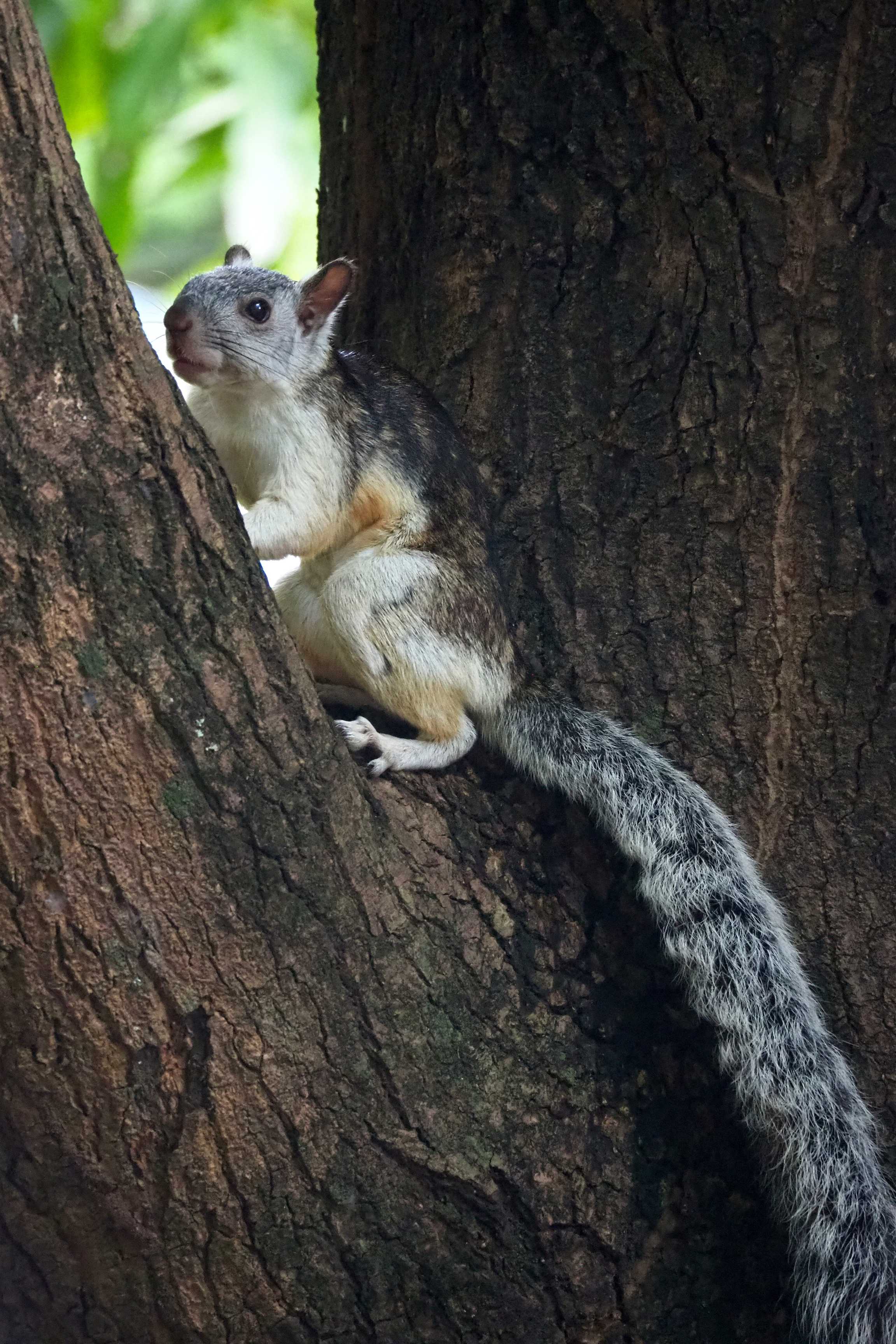
And speaking of native, here is a beautiful one... A variegated squirrel, Sciurus variegatoides.



Puerto Momotombo
We leave the ruins of Viejo León not far behind to reach the shores of Lake Xolotlán in Puerto Momotombo. Here we are in front of a pretty picture where the Momontombo volcano imposes itself on us with its perfect silhouette and its vegetation trying to envelop it... The mastodon is not alone, it is accompanied by its mini-clone that we can guess on the right, isolated in the middle of the lake, logically called Momotombito...

Some swimmers brave the slight waves of the lake.


On the right, the Momotombito volcano


We take advantage of one of the village restaurants, with "tostones con queso", fried plantain banana slices served with a piece of cheese on top.


León
Return to León in front of the "El Calvario" church. Its neoclassical style construction began in 1786 and was completed in 1801. Then, it underwent new restorations to repair the damage caused by the various earthquakes.


The interior of "El Calvario".


View of the cathedral from El Calvario.

Las Peñitas Beach
Relaxing afternoon 30 minutes from León, on the beaches of Las Peñitas.


The sea is agitated and the waves reach beautiful heights. This does not stop us from enjoying the water with temperatures much higher than that of our French Atlantic coast!


And superb sunset to end the day! 


Dinner in León at the restaurant El Bodegon. Tomorrow, the saga of volcanoes continues with the Cerro Negro and the Telica! Unlike today, we will not observe them from afar, but we will climb on them! 

Latest comments
On Guatemala 2018
Le 25 Novembre 2024
Significado de este mural
On Chile 2016
Le 15 Septembre 2024
Rrrrrr
On Egypt 2003
Le 1er Avril 2023
Et oui c'est bien nous aux pieds de ce Colosse !
Le 1er Avril 2023
Bien petits aux pieds de ce Colosse !
On Namibia 2014
Le 3 Août 2021
very good indeed