


 My blog



Monday13October
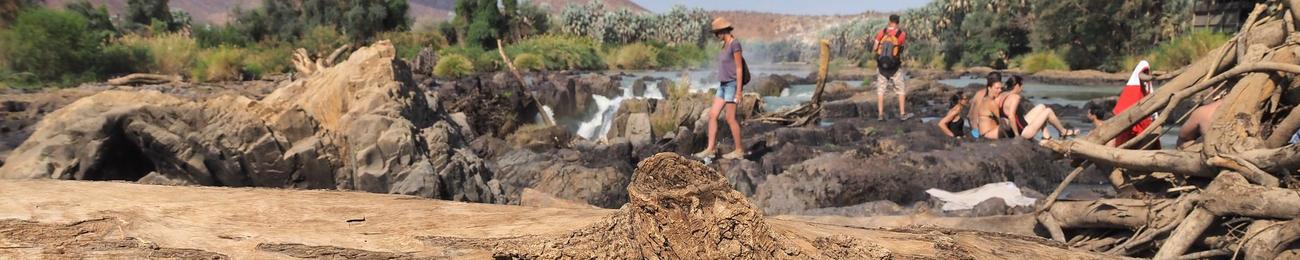
Early morning wake-up at the Omarunga campsite in Epupa Falls, bordering the Kunene River.


This morning, we leave our spot n°3 to go meet Himbas in their village.

The encounter is organized by the campsite. We therefore fear that the meeting will be totally "manufactured" and artificial... Alas, this formula will not prove us wrong. Dropping about fifteen tourists laden with cameras into a local's home, every day, makes genuine exchange and natural interaction difficult... Certainly, the Himbas have found a compromise here to preserve their culture while earning a little money and bags of rice brought by tour operators, but in return, this somewhat distorts the cultural exchange...

So here we are in the village. We will stay there for barely an hour and a half. The language barrier and the programmed intrusion amplify the shyness on both sides. Nevertheless, the rules are set, we have carte blanche for photos... Fortunately, towards the end, a real exchange will begin, especially with the visit of the huts and also thanks to the children!


The Himbas are nomadic. They live thanks to the livestock they raise: cows, goats, chickens...


Their way of life is ancestral and struggles to resist the modern world that surrounds them on all sides. Fewer and fewer choose to stay in the villages. There would only be about ten thousand left.
The first particularity of this people concerns the women and the importance they give to their cosmetics. Indeed, they completely coat their bodies, including their hair, with a kind of oil based on animal fat mixed with red ochre, not to protect themselves from the sun or mosquitoes, but simply to enhance their appearance as much as possible!


A whole language also accompanies their incredible hairstyles. If the braids fall in front of the shoulders, then the adolescent is in full puberty. If, on the contrary, the hair remains at the back of the head, then the woman is married. This is probably theoretical because I have the impression that the braids come and go with head movements... 

This woman accompanies her hairstyle with a leather headdress signifying that she has had her first child or has been married for a year.

A "pontok", name given to huts made of branches, clay, and cow dung.


Necklaces are as important as hairstyles in Himba language.

Children keep their heads shaved until circumcision. After that, only the crown of the head is not shaved.


Modesty is located at the ankles! That's why they are completely covered.


Yes, yes, I know, it feels weird to me too to take your picture...

But it's okay, it doesn't seem to bother you that much after all... 


The interior of the pontok. A few hooks on the walls, embers under a fabric dome (left photo) and an opening in the ceiling for light.


And to break the ice, nothing beats children who don't invent barriers to communicate with strangers! These two little Himbas come to examine Rico's camera more closely. Then, a proper inventory follows of everything related to fastening systems... Lids, zippers, velcros, buttons, clips, etc...! My bag was thus tested thoroughly and passed Himba standards with flying colors!


A visit never ends without a souvenir shop. Here too...


The huts are placed in a circle around the goat enclosure to protect them from predators.

We leave the village and continue the tour with a visit to a school for Himbas so that they too can benefit from knowledge complementary to their culture, especially to learn English, the official language of the country. It is also a sign of acceptance and openness to the world around them, which is evolving very differently from their own...


Outside, it's lunchtime. A large pot is placed in the middle of the courtyard to fill the students' plates.


In front of the school, a young baobab and its fruits.


Latest comments
On Guatemala 2018
Le 25 Novembre 2024
Significado de este mural
On Chile 2016
Le 15 Septembre 2024
Rrrrrr
On Egypt 2003
Le 1er Avril 2023
Et oui c'est bien nous aux pieds de ce Colosse !
Le 1er Avril 2023
Bien petits aux pieds de ce Colosse !
On Namibia 2014
Le 3 Août 2021
very good indeed