


 My blog
  Support me on Tipeee!




Wednesday15October
After spending the night in a house at Oppi Koppi Restcamp, we re-enter Etosha National Park with our own car for 2 days. No less is needed to cross this nature reserve, as it is an area the size of an entire region that has been made available to wild animals.

Once inside the park, we are forbidden to leave the car under penalty of expulsion. Certain fenced areas are provided for picnics and other amenities... A large campsite is also located halfway through the route. We will spend the night there. For now, we gently begin the photo safari with a red-billed francolin (Pternistis adspersus). 


A main track crosses the park from west to east, and a few other tracks allow you to venture deeper into the savannah. No barriers separate visitors from the animals... Knowing that we are in the territories of lions, jaguars or other hyenas, it is important to remain vigilant. For now, no fierce predators, but simple giraffes dining at the foot of an acacia...

A Kori bustard (Ardeotis kori). This large bird (120 cm) is frequently seen in this park.

Many gemsboks (Oryx gazella) and zebras. The latter, like all equids, dislikes solitude and mixes with other animal species, as long as they remain friendly... 


I still can't tell if these are Hartmann's zebras (Equus zebra hartmannae) or Burchell's zebras (Equus quagga)... I would lean towards Hartmann's zebra because the color of its stripes is slightly orange, but I might be wrong... 


The strange and funny warthogs (Phacochoerus africanus).

Waterholes scattered throughout the park ensure that you can observe the various animals that gather here in complete cordiality.

In the tall grass, a black-backed jackal (Canis mesomelas) on the lookout for a small prey or an insect to eat...

The springbok (Antidorcas marsupialis), our constant companion given that we saw it practically everywhere...

Rubbing shoulders with zebras or greater kudus, that's the great lady's pastime...


The great lady also bows to quench her thirst.


This leaves her two neighbors speechless...

"But? Where did my friend go?"

"Oh, how silly of me, she just bent down to drink..." 

The French cancan is preparing backstage...

The hooded vulture (Necrosyrtes monachus). When it's not circling in the sky looking for carcasses, it rests peacefully high up in a tree, far from other animals.


Around a bend in the road, STOP! The big cats are here! Under the shade of a bush, a lioness (Panthera leo) is cooling off...


A little further on, it's the lion cubs themselves basking in contact with their mother...


Shhh... Let's hope they don't spot this pretty steenbok raphicerus...

What? An animal skin and no fireplace???

Wow, a magnificent elephant (Loxodonta africana) just two steps away from us! There are about 2000 pachyderms in the park.


Quiet strength.


Its enormous ears allow it to cool itself by fanning them.


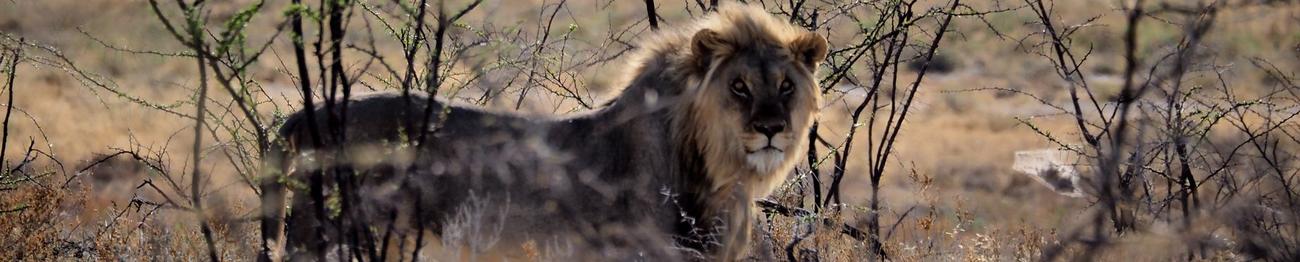
Whoa! We had the mom, here's the dad... The savannah lion. He must be tracked by local scientists because he has a tag around his neck.


A herd of blue wildebeest (Connochaetes taurinus).


Here, it's not the farmyard, but the high court... The African ostrich (Struthio camelus australis) raises the bar...


In the distance, a herd of elephants led by the matriarch, the oldest female.


The onboard air conditioning, ear-style, is working at full capacity...
The Acacia erioloba, King of the savannahs.

And here is our first rhinoceros. Don't worry, we'll see others!

A discreet pale chanting goshawk (Melierax canorus) that remained silent...


Again, the Kori bustard.


The day ends and here we are in the strategically located campsite in the center of the Etosha reserve: Okaukuejo Camp. On the outskirts of the campsite, an artificial waterhole has been made available to animals. So we can quietly finish the evening, sitting in the breeze, facing the wild panorama colored by the sunset.


Gradually, the animals come one by one to quench their thirst.


Night has fallen. The campsite lights slightly illuminate the waterhole, enough to take a few photos of the big cats who don't think they are being watched...


Then follows the bath of Messrs. Rhinoceros...


Alright, off to bed! Tomorrow awaits our second day of exploring the eastern part of the park!
Latest comments
On Guatemala 2018
Le 25 Novembre 2024
Significado de este mural
On Chile 2016
Le 15 Septembre 2024
Rrrrrr
On Egypt 2003
Le 1er Avril 2023
Et oui c'est bien nous aux pieds de ce Colosse !
Le 1er Avril 2023
Bien petits aux pieds de ce Colosse !
On Namibia 2014
Le 3 Août 2021
very good indeed