


 My blog


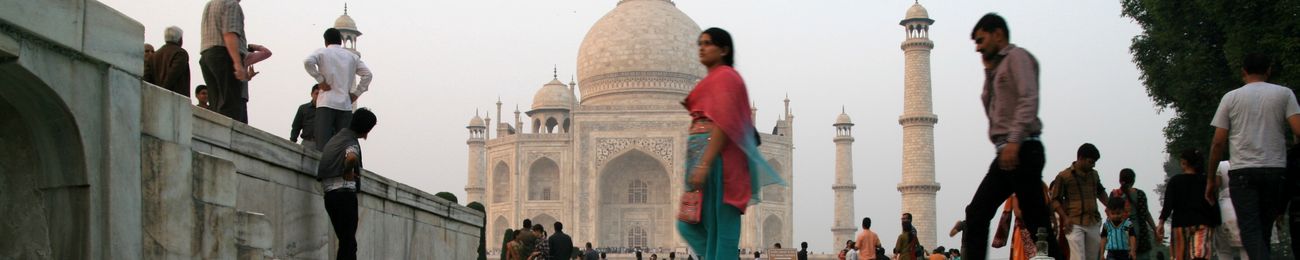


The Red Fort of Agra
Agra, capital of the Mughal Empire in its time, had to have a palace worthy of the greatest rulers. The first of these was the Mughal emperor Akbar who, in 1565, had the small fort rebuilt into a palace capable of accommodating his son Jahangir.


There's no false advertising... The Red Fort of Agra is indeed red... 
2.5 kilometers of red sandstone wall surround the site


A lace of arches.
Ha, it's been a long time! A palm squirrel (Funambulus pennantii)!


In the distance, the Taj Mahal blends into the morning mist.

Emperor Shah Jahan, who had the Taj Mahal built, was imprisoned in the Red Fort. From his golden prison, he could thus see the work of his life... He died here on January 22, 1666, at the age of 74.


Inside, the red sandstone gives way to white marble.


Diwan-i-Am, the Hall of Public Audience.


The Khas Mahal Palace


The fort was added to UNESCO's World Heritage list in 1983.


Ceilings with incredible reliefs.


In this room, the walls are entirely composed of niches, no idea what the function of this room is. 


Let's not spoil our pleasure, the already beautiful place becomes sublime when the Sun adds its rays!


In the outer gardens, the Jahangir's hauz: Emperor Jahangir's portable stone bathtub!


Persian inscriptions were carved on the sides. They notably give the year of construction of the monolithic block, 1610.
A small staircase allowed one to descend into their bath 

The Tomb of Akbar the Great
We move a few kilometers away from the city of Agra to reach the last resting place of Akbar, considered the greatest of the Mughal emperors. Since we are in the Agra region (oh yes, we are no longer in Rajasthan!), his name revolves around all the monuments we have visited.
The arrival is through this impressive gate which, by its extreme sophistication, signifies that you are entering a place of primary importance. It even has four minarets, which is not the case for the mausoleum itself.


Between the gate and the mausoleum, a magnificent park will make the short walk very pleasant.

You won't be the only ones to enjoy the park; blackbuck antelopes (Antilope cervicapra) act as low-cost lawnmowers...


On one side, backlit, the gate we just passed through. Facing it, the tomb of Akbar the Great.


Asian cattle egrets (bubulcus coromandus) or rather, in this case, Indian antelope guards...


A male (recognizable by its magnificent twisted horns) ventures outside the lawns and indicates to tourists that he is indeed the boss here (after Akbar, of course)... 


The interior as well as the exterior is superb.


Like an Egyptian underground tomb, a long, high, narrow corridor leads us to the crypt where the body of Emperor Akbar rests (or rather rested, as the site was desecrated in 1688, leaving nothing of the sovereign's body).

In the immense hall, a small, high-set opening dimly illuminates the tomb of the third Mughal emperor.


Back to the mausoleum entrance.


From there, one can access the other tombs of the mausoleum, those of his wives and children.


Arches surround the building.


And so, in the evening, we return to New Delhi, which means the end is near, but not quite, as we still have two full days to stroll around the capital!
Latest comments
On Guatemala 2018
Le 25 Novembre 2024
Significado de este mural
On Chile 2016
Le 15 Septembre 2024
Rrrrrr
On Egypt 2003
Le 1er Avril 2023
Et oui c'est bien nous aux pieds de ce Colosse !
Le 1er Avril 2023
Bien petits aux pieds de ce Colosse !
On Namibia 2014
Le 3 Août 2021
very good indeed