


 My blog



Wednesday30October
We leave Roissy on Wednesday morning to reach San José via New York where we have several hours of transit at Newark airport.


In the distance, through the fog, we can make out the new Freedom Tower which replaced the Twin Towers of the World Trade Center. It will officially be the tallest tower in the United States in 12 days!

We arrive that evening at San José airport, the capital of Costa Rica, 20 hours after leaving Paris.

We had booked a night at the "Chez Pierre Casa Tago" Hotel in the nearby town of Alajuela. As planned, they are there to take us directly to the hotel!
Thursday31October
First step, pick up our rental car which is delivered directly to the hotel.


On the left, our room. On the right, our Toyota Rav4 which will transport us for 21 days.
After 4 hours by car heading east of the country, we arrive at La Pavona, where we leave our car to take the boat that will take us to Tortuguero.


We eat on site the typical dish of the country: Casado, a marriage (hence its name) of rice with red beans, accompanied here by meat and bananas.
The pier where 1 hour of navigation to Tortuguero begins.


On the banks, some animals deign to show themselves, cows, a great egret and a red-headed vulture.


Short stop for merchandise drop-off


17h and a bit, here we are in Tortuguero.

We find a room next to the beach. For tomorrow, the owner offers us a small boat excursion with his brother who will serve as our guide. Perfect for us, we won't have to waste time organizing the day!

Breaded fish for dinner
In the canals of Tortuguero Park
We have an appointment at 8:00 AM. We cross the village to reach the meeting point, an opportunity to see in broad daylight where we have set foot!

A typical house in Tortuguero
And off we go for 3 hours of walks in the park's canals.

Several canals allow you to dive into the tropical forest.


The guide has a keen eye and shows us a Bare-throated Tiger Heron (Tigrisoma mexicanum) well settled in its nest.


Followed by a Northern Jacana (jacana spinosa) accustomed to walking on aquatic plants.

And in the distance, a great egret (Ardea alba)

We dock to explore the surroundings on dry land.


Our guide slips away for a few minutes and returns with a tiny little red frog in his hands.


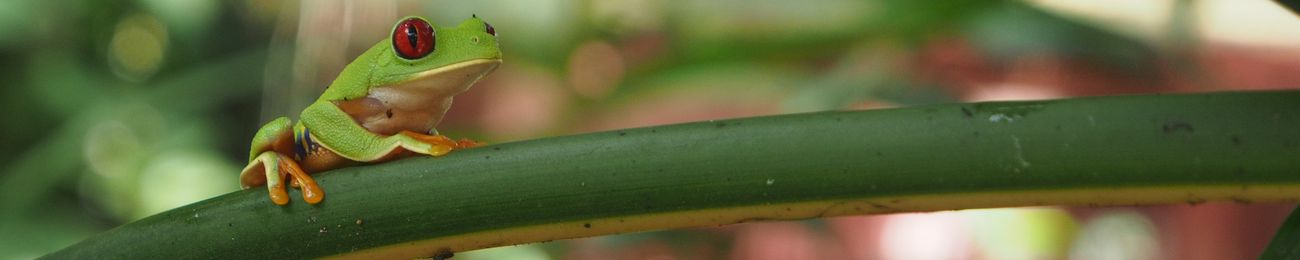
It's an Oophaga pumilio, also called strawberry poison-dart frog. Costa Ricans call it the blue jeans frog because of its blue hind legs.


It measures about 2 centimeters. Tiny and superb! Colorful frogs are a must-see in the country, now we can say it, we are truly in Costa Rica!


We get back in the boat to continue exploring the surroundings

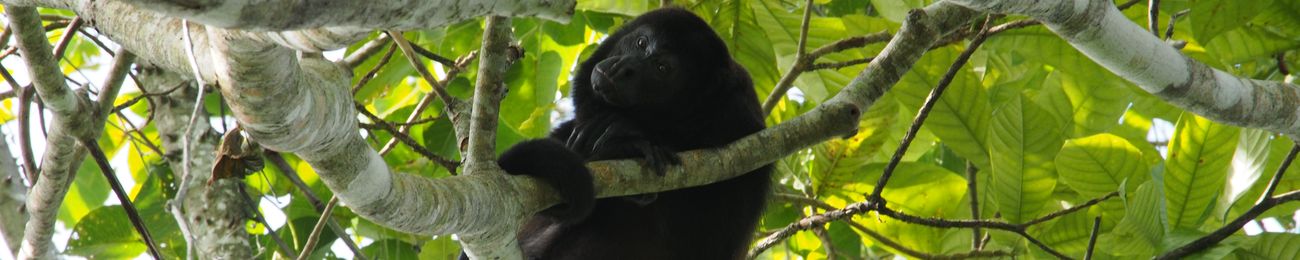
In the distance, cries make us look up, a howler monkey (alouatta caraya) proudly shows us its all-white attributes...

A little further on, a lizard patiently waits on a branch just above the water.

It's a female plumed green basilisk (basiliscus plumifrons) also called the Jesus Christ lizard because it moves so fast it can walk on water!
We'll see a few of them perform this small miracle, but they're far too fast for us to film them!
A little further and higher up, another reptile is basking in the sun. It's a green iguana, iguana iguana.

The area is really quiet; we'll only cross paths with one other boat. November isn't peak tourist season, and that's a good thing.

Another branch, another iguana.

There are reptiles, for sure, but our guide is really keen on finding us the biggest one around, the caiman! It's done by searching a bit on the sides of the river under the plants...


It's a spectacled caiman (caiman crocodilus). It measures about 2 meters and is very calm during the day. In any case, we've never seen them be aggressive...
Click to see the beauty of its eye!

Time to greet this great heron (ardea herodias) and we resume navigation to return to the village.


Lunch with beef fajitas with rice and avocado

Then back to our accommodation. We didn't even have time to see this beach located in front of our room!


We are in front of the Atlantic Ocean, but more precisely in the Caribbean part!

In Tortuguero, the beaches are quite wild and the sea is rough. So no swimming. We'll make up for it in the south of Costa Rica!


Our hotel Balcon del mar.

The rooms are rather old-fashioned, but a line of hammocks is set up in front for a nap! The hammock is another must-have in Costa Rica, it's everywhere! 

Friday1stNovember
In the forest of Tortuguero National Park
After the morning boat trip, we will walk on the trail that crosses a part of Tortuguero National Park.

Watch where you step! Don't accidentally crush a trail of leaf-cutter ants!


The trail runs along the entire beach

Various exotic plants


Crabs live in holes. Here, a ghost crab (an ocypode).


Insects are not to be outdone either. Here is an anisocelis flavolineata bug with its orange 'fin' legs...


On the right, a termite mound built on a tree trunk.


Then, out of nowhere, a red brocket deer (mazama americana) appears, a doe with large eyes and small antlers.

The beaches of Tortuguero and the green turtles
Return via the beach. We were told that at dusk, there might be turtles... But it all looks very deserted... 

And what's more, black vultures (coragyps atratus) are there, watching for the slightest emergence of the shelled reptile...


Here's one that wasn't lucky. Only bones and scales remain.


A little further on, it's the small shell of a baby turtle that didn't have time to reach the ocean... 

These beaches are visited by thousands of turtles that come to lay dozens of eggs in the sand, a real pantry for the vultures. But the sheer number helps compensate for the inevitable losses between eggs that don't hatch and babies that are eaten on land or in the sea.

In any case, it's not today that thousands of turtles will come to lay eggs here, nor that all the eggs will hatch at the same time. Apart from the vultures, we only encounter a few peaceful long-billed curlews (numenius americanus).

But it's when you least expect it that it happens! The fresh flipper prints leave no doubt, they were here recently!

And indeed, here she is! Alone facing her destiny, she mechanically and tirelessly wiggles her small flippers with only one idea in mind: to reach the water a few meters from the sand hole she just emerged from.

It's truly moving to be faced with this little ball of energy that, in its first moments of life, is already confronting a difficult survival challenge. I invite you to experience this small journey up close with my onboard camera! ;-)
And thank you Christophe for the little helping hand that lightened our little turtle's task 
So, it is with a heavy heart that we left our valiant chelonian in the immensity of the ocean. Let's cross our fingers that it hasn't already been devoured by a large passing fish... 
But the beach is long, and we might encounter others.


A dead tree trunk and a log used to remove coconut fibers
And a little further on, here are the cousins who, in turn, emerge from their hole. They also struggle to advance through these labyrinths of sand waves.


These are green turtles or flatback turtles (chelonia mydas). The eggs incubated for almost two months in the sand at the top of the beach. In a few years, these small turtles, if they survive, will return here to lay their own eggs.


Man vs Wild 


It can reach 1.40 meters in adulthood!
Come on, courage! Just a few more meters!


That's it! The promised sea is finally reached!

Back to the village. Tonight a music band provides entertainment.


Saturday2ndNovember
Early wake-up to leave Tortuguero. A last quick look around the room and surroundings to make sure nothing is forgotten, and off we go for the boat trip back to the car park where we left our car 2 days ago.


Panoramic view of the "Balcon del mar" rooms


Latest comments
On Guatemala 2018
Le 25 Novembre 2024
Significado de este mural
On Chile 2016
Le 15 Septembre 2024
Rrrrrr
On Egypt 2003
Le 1er Avril 2023
Et oui c'est bien nous aux pieds de ce Colosse !
Le 1er Avril 2023
Bien petits aux pieds de ce Colosse !
On Namibia 2014
Le 3 Août 2021
very good indeed